Deel vs Papaya: Choosing Between Two Global Payroll Giants
In the fast-growing remote-work market, conducting a Deel vs Papaya comparison is essential for any business looking to hire globally.
Tools like Deel and Papaya Global have become leading solutions in the global payroll space, helping companies manage compliance, contracts, and payments across multiple countries.
But here’s the challenge:
Both platforms offer similar promises — global coverage, payroll automation, and compliance support — yet they take very different approaches behind the scenes.
So the real question is not simply which platform is “better”…
👉 But which one is better for your specific situation?
In this comparison, I’ll break down the key differences between Deel and Papaya, drawing on real data and practical insights to help you make a clear, informed decision.
If you want a full breakdown of Deel, check my detailed review here.
Quick Overview: Deel vs Papaya
In this Deel vs Papaya comparison, we’ll break down pricing, features, and real-world use cases.
At a high level, both Deel and Papaya Global aim to solve the same problem: helping companies hire, pay, and manage international teams without navigating complex legal and financial systems.
However, once you look beyond the surface, the differences become more noticeable — especially in pricing structure, hiring models, and how each platform approaches global expansion.
| Feature | Deel | Papaya Global |
|---|---|---|
| Global Coverage | 150+ countries | 160+ countries |
| EOR Pricing | Starts at $599/month | Starts at $599 (can go higher depending on country) |
| Contractor Management | ~$49 per contractor | ~$30 per contractor |
| Hiring Model | Own entities (Direct) | Local partners (ICPs) |
| G2 Rating (2026) | 4.8 / 5 | 4.5 / 5 |
What These Numbers Actually Mean
At first glance, both platforms appear very similar in terms of pricing and global reach.
But the real difference is not just in the numbers — it’s in how these platforms operate and who they are built for.
For example, while both start at a similar base price for Employer of Record (EOR) services, Papaya’s pricing can scale higher depending on the country and complexity. On the other hand, Deel’s pricing tends to be more predictable, which can be important for growing teams.
Another key difference is contractor pricing.
Deel charges around $49 per contractor, while Papaya is closer to $30. This may not seem significant at first, but for companies managing dozens — or even hundreds — of contractors, the cost difference becomes substantial.
The hiring model is also worth paying attention to.
Deel operates through its own legal entities in many countries, allowing for greater control and faster onboarding. Papaya, by contrast, often relies on local partners, which can provide flexibility but may add layers to the process.
👉 In short, while the numbers look similar, the experience and operational approach behind each platform can feel very different in practice.
Key Differences That Actually Matter
While both Deel and Papaya Global offer similar core features, the real differences become clear when you look at how each platform performs in real-world scenarios.
Ease of Use & Onboarding Speed
One of the most noticeable differences is how quickly you can get started.
Deel is built with a strong self-service approach. The interface is intuitive, and most processes — from creating contracts to onboarding employees — can be completed without needing external support.
This makes Deel particularly attractive for startups or fast-moving teams that need to hire quickly across multiple countries.
Papaya, on the other hand, tends to offer a more structured and guided setup process. While this can be beneficial for larger organizations, it may feel slower or more layered compared to Deel’s more streamlined experience.
👉 In short: Deel is faster and more user-friendly, while Papaya is more structured.
Pricing & Cost Structure
Pricing is another area where the differences become more practical.
At first glance, both platforms start at similar price points for EOR services. However, as mentioned earlier, Papaya’s pricing can vary by country and complexity.
Deel’s pricing is generally more predictable, which can be helpful for companies planning their budgets.
When it comes to contractors, Papaya is more cost-effective (around $30 vs. ~$49 on Deel). For businesses managing a large number of freelancers, this difference can add up quickly.
👉 In short: Papaya can be more cost-efficient at scale, while Deel offers more predictable pricing.
Compliance & Legal Structure
Both platforms focus heavily on compliance—but they approach it differently.
Deel operates through its own legal entities in many regions, giving it more direct control over hiring and employment processes. This often results in faster onboarding and fewer intermediaries.
Papaya relies more on local partners (ICPs), which can provide flexibility and localized expertise but may also add layers to the workflow.
👉 In short:
Deel = more control and speed
Papaya = more flexibility and a localized approach
You may also want to compare Deel with Oyster HR.
Scalability & Reporting
This is where Papaya starts to stand out more clearly.
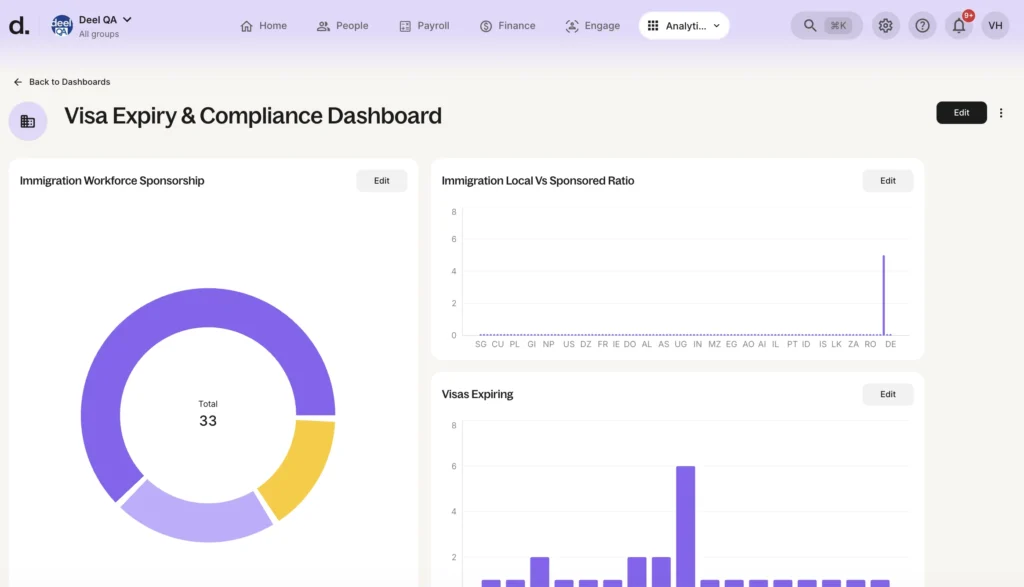
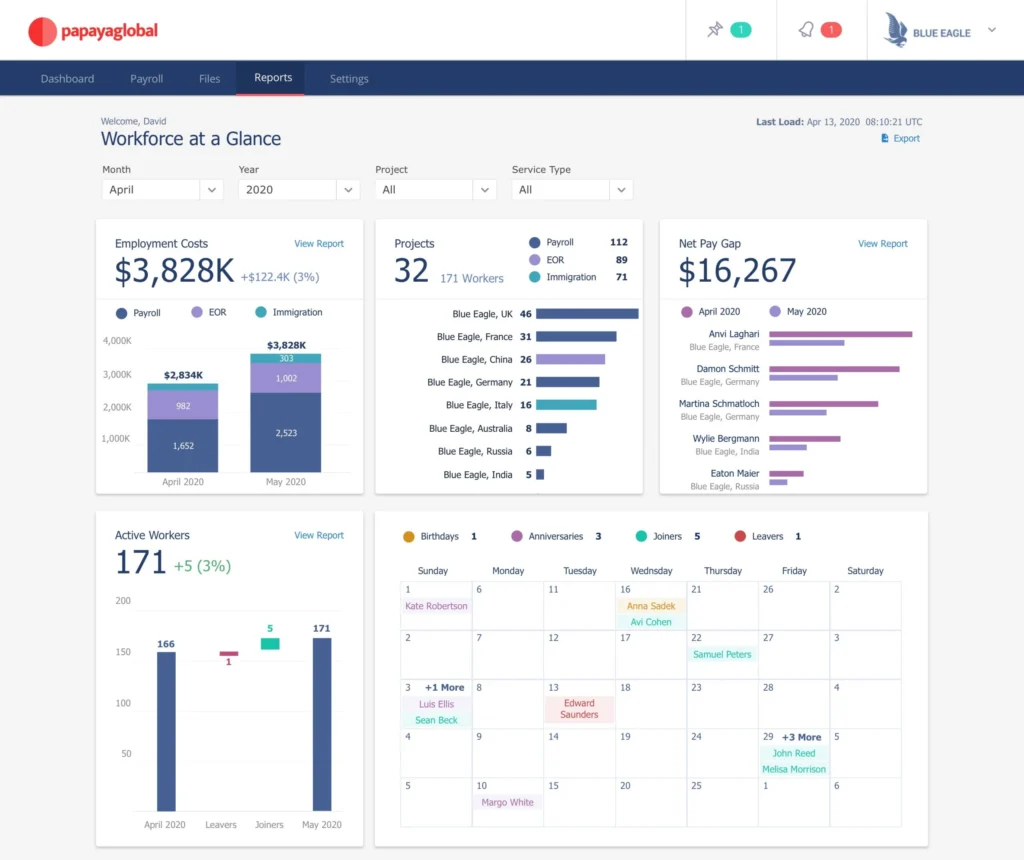
Papaya is designed with larger organizations in mind, offering more advanced payroll analytics and reporting capabilities. This can be especially valuable for companies managing complex global operations and large budgets.
Deel, while still scalable, focuses more on operational simplicity and execution rather than deep financial insights.
👉 In short:
Papaya is stronger in analytics and reporting, while Deel focuses on ease and execution.
I’ve also explained Deel’s payroll system in more detail in this guide.
Deel vs Papaya: Pros and Cons
To make the comparison easier to scan, here’s a side-by-side look at what each platform does best — and where each one may fall short.
Deel Pros
- Fast onboarding with a self-service workflow
- Direct legal entities in many countries (fewer intermediaries)
- User-friendly interface — easy for non-HR teams
- High user satisfaction (strong G2 rating)
- Predictable pricing structure for most use cases
Deel Cons
- Higher contractor cost (~$49 per contractor)
- May feel overbuilt for very small teams
- Limited advanced analytics compared to enterprise-focused tools
Papaya Global Pros
- Lower contractor pricing (~$30 per contractor)
- Advanced payroll analytics & reporting
- Designed for enterprise-scale operations
- Strong financial visibility across global teams
- Flexible approach through local partners (ICPs)
Papaya Global Cons
- Onboarding can be slower due to the multi-layer structure
- Pricing can vary significantly by country
- The interface may feel less intuitive for new users
- Reliance on partners may introduce extra coordination steps
Pricing Comparison: Deel vs Papaya
When comparing Deel and Papaya Global, pricing is one of the most important — and sometimes most confusing — factors.
At a base level, both platforms offer Employer of Record (EOR) services starting at around $599 per employee per month. However, this number does not always reflect the full picture.
EOR Pricing (Employees)
Both Deel and Papaya start at a similar price point, but their pricing scales differently.
Deel’s pricing tends to be more predictable across countries, which makes it easier for companies to plan their budgets as they grow.
Papaya, on the other hand, may adjust pricing depending on the country, complexity, and local regulations. This can lead to higher costs in certain regions, especially for more complex employment setups.
👉 In practice:
Deel = more predictable pricing
Papaya = more variable, but sometimes more tailored
Contractor Pricing: Deel vs Papaya
This is where a clearer difference appears.
Deel typically charges around $49 per contractor, while Papaya is closer to $30.
For small teams, this difference may not be significant. But for companies managing large numbers of freelancers, the cost gap can become substantial over time.
👉 In practice:
Papaya = more cost-efficient for contractors
Deel = more expensive, but with a more integrated system
Hidden Costs & Scalability
Another important aspect is how pricing evolves as your team grows.
Deel’s model is generally straightforward, which reduces surprises when scaling. What you see is often close to what you pay.
Papaya’s pricing structure can be more flexible, but also more complex. Additional services, integrations, or country-specific requirements can influence the final cost.
👉 In practice:
Deel = simpler, more transparent pricing
Papaya = more flexible, but requires closer evaluation
Final Pricing Insight
At a glance, both platforms appear similar in pricing — but the real difference lies in how predictable and scalable that pricing is.
If you value simplicity and cost predictability, Deel may feel more comfortable.
If your priority is optimizing costs at scale (especially for contractors), Papaya can offer better efficiency.
Which One Should You Choose?
Choosing between Deel and Papaya is not about which platform is better overall — it’s about which one fits your specific needs.
Choose Deel if:
- You are a startup or a growing company
- You need to hire quickly across multiple countries
- You prefer a simple, self-service platform
- You want predictable pricing without too many variables
In these cases, Deel offers a faster and more streamlined experience, making it easier to scale without operational friction.
Choose Papaya Global if:
- You are managing a large or enterprise-level organization
- You need advanced payroll analytics and reporting
- You want deeper financial insights into global workforce costs
- You are optimizing costs across a large contractor base
In these scenarios, Papaya provides stronger financial visibility and reporting capabilities that become more valuable at scale.
If you want a deeper breakdown, you can read my full Papaya Global review here.
💡 Quick Decision Guide
👉 Looking for speed, simplicity, and fast onboarding?
Deel → Try Deel
👉 Need advanced payroll insights and enterprise-level reporting?
Papaya → Explore Papaya

Final Verdict: Deel vs Papaya
Both Deel and Papaya Global are powerful platforms — but they are built for different types of users.
Deel stands out for its speed, ease of use, and streamlined onboarding experience. It’s an excellent choice for startups and growing companies that need to move fast and manage global hiring without unnecessary complexity.
Papaya Global, on the other hand, shines in advanced payroll analytics and enterprise-level workforce management. For larger organizations that require deeper financial visibility and reporting, it offers a more data-driven approach.
Ultimately, this Deel vs Papaya comparison highlights that the right choice depends on your business size and priorities.
👉 In the end, the better platform is not the one with more features — but the one that aligns with how your business operates.
If you’re still unsure, the best way to decide is to explore each platform and see how it fits your workflow.
FAQ: Deel vs Papaya Comparison
Is Deel better than Papaya?
In this Deel vs Papaya comparison, Deel is generally better for startups and fast-growing companies that need quick onboarding and a simple user experience, while Papaya is better suited for larger organizations that require advanced payroll analytics.
Is Papaya cheaper than Deel?
Papaya is often more cost-effective for contractor management, but this Deel vs Papaya comparison shows that total pricing depends on company size, country, and use case.
Which platform is best for global payroll?
This Deel vs Papaya comparison shows that Deel is better for ease of use and speed, while Papaya is stronger in analytics and enterprise-level payroll management.
Can small businesses use Deel or Papaya?
Yes, but in this Deel vs Papaya comparison, Deel is more suitable for small and medium businesses, while Papaya is generally better suited for larger companies.

James B. has 8 years of experience in online business and digital publishing. At EarnGoGo, he researches and writes about HR, payroll, global employment, and employment compliance, focusing on how technology and AI are changing the way companies hire and manage international teams.