The Part of AI Hiring Most Guides Skip
Over the past year, I’ve watched the AI hiring stack evolve from a collection of emerging tools into the starting point for modern recruiting teams. AI can now source candidates across borders in hours instead of weeks and screen hundreds of resumes in minutes instead of days.
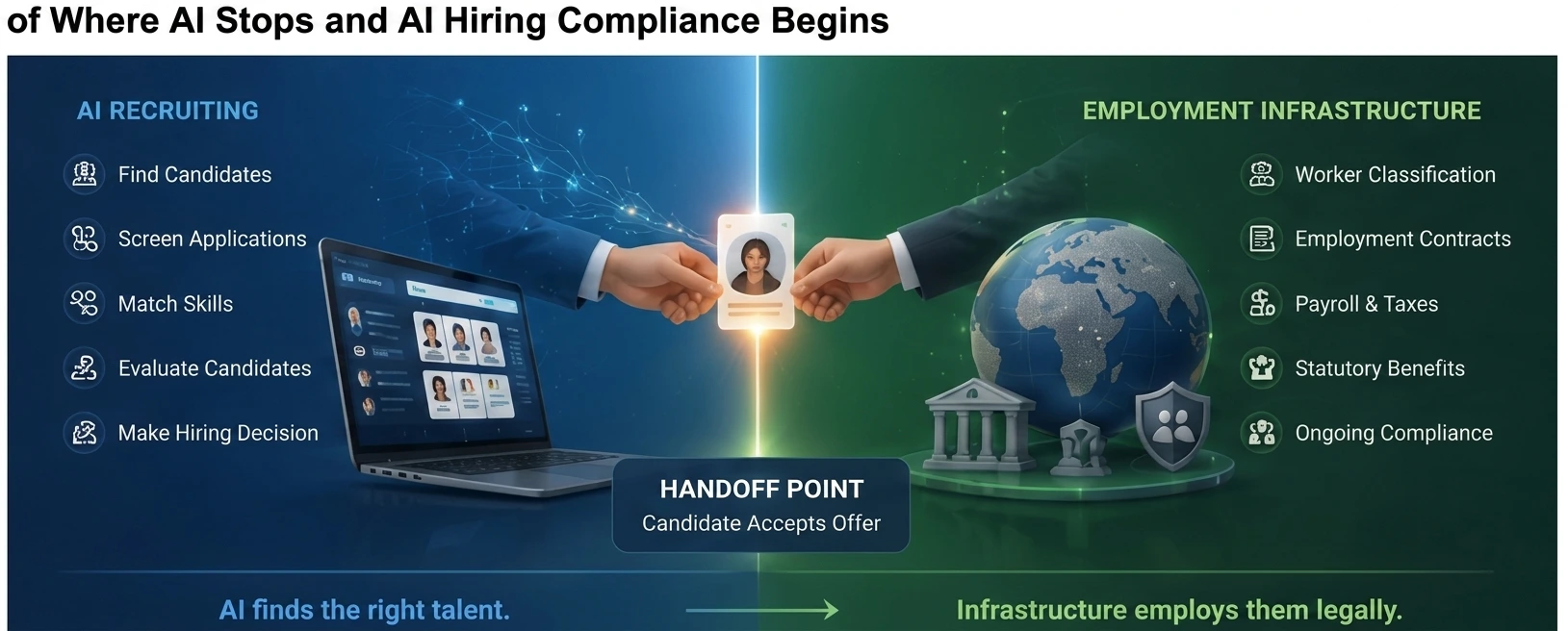
But here’s the part most AI hiring guides skip: the moment a candidate accepts an offer, AI’s job is essentially done—and a completely different set of questions takes over. Is this person an employee or a contractor under local law? Which country’s labor rules apply? Who handles payroll, taxes, and statutory benefits?
This is where the AI hiring stack shows its limits. Companies that treat AI as the entire hiring solution, rather than the first half of it, are the ones most likely to run into misclassification risk or payroll delays down the line.
The way I see it: AI is the intelligence layer of the modern hiring stack. Employment infrastructure is the operational layer that makes the hire actually legal, payable, and sustainable. In 2026, companies hiring across borders need both—and confusing one for the other is where things go wrong.
The Modern AI Hiring Stack
Global hiring in 2026 runs on two layers, and most companies only think seriously about one of them.
The first layer is AI—sourcing candidates, screening resumes, and matching skills to roles. The second is what I’d call the employment infrastructure layer: everything that turns a “yes” from a candidate into a legal, payable employment relationship. AI hiring compliance sits exactly at the seam between these two layers, and it’s where most of the risk in global hiring actually lives.
This isn’t a theoretical shift. SHRM’s 2025 Talent Trends research found that 43% of organizations now use AI for HR-related tasks, up from just 26% in 2024, and recruiting is the function where adoption is highest: 51% of organizations report using AI to support recruiting activities specifically. The most common uses are job-description writing, resume screening, automated candidate searches, and applicant communication — and among organizations already using these tools, 89% of HR professionals say AI saves time or improves efficiency.
I’d frame it this way: AI isn’t just another recruiting tool anymore. It’s becoming part of the infrastructure companies rely on to move candidates through the funnel. But that funnel doesn’t end when AI finds the right person—it continues through worker classification, contracts, payroll, taxes, benefits, and ongoing compliance. That second half is where AI hands off and where employment infrastructure takes over.
The Two Layers of the 2026 Hiring Stack
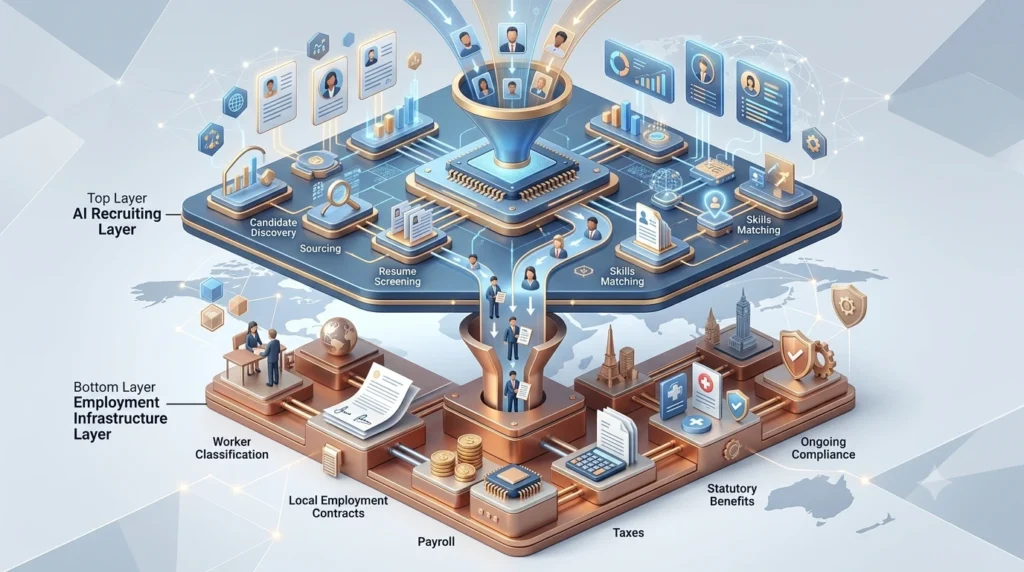
The AI layer focuses on speed and intelligence:
- Finding potential candidates
- Screening applications
- Matching skills to roles
- Supporting candidate assessments
- Automating repetitive recruiting tasks
The employment infrastructure layer focuses on what happens after the hiring decision:
- Establishing the right employment relationship
- Preparing locally compliant documentation
- Managing worker classification
- Running payroll and handling statutory requirements
- Administering benefits and ongoing compliance
These two layers solve different problems, but in global hiring, they can’t really function in isolation from each other anymore.
The Modern Hiring Stack: AI vs. Employment Infrastructure
To understand where the risk lives in cross-border recruitment, it helps to compare the core responsibilities of each layer side-by-side:
| Feature / Dimension | The AI Layer (Top Funnel) | The Infrastructure Layer (EOR / Employment Infrastructure) |
|---|---|---|
| Primary Focus | Finding, sourcing, and screening candidates | Making the hire legally compliant and operationally sustainable |
| Core Function | Automates candidate discovery, matching, screening, and communication | Handles employment contracts, payroll, taxes, benefits, and ongoing compliance |
| Key Limitation | Cannot replace local employment and regulatory infrastructure | Does not replace the AI-driven sourcing and screening process |
| Success Metric | Speed, candidate quality, and recruiting efficiency | Compliance, accurate payroll, and sustainable global employment |
| Role in Workflow | Identifies and evaluates the right candidate | Turns the accepted candidate into a compliant, payable employee |
The scale of this shift is hard to overstate. The World Economic Forum’s Future of Jobs Report 2025 — based on input from over 1,000 employers representing more than 14 million workers across 55 economies — found that 86% of employers expect AI and information-processing technologies to transform their businesses by 2030. Meanwhile, 69% plan to recruit talent skilled in AI tool design, and 62% expect to hire people who can work alongside AI systems.
As companies compete for that talent across borders, finding the right person is only step one. The harder question—the one I see founders underestimate constantly—is what happens after the candidate says yes.
The AI-Driven Top Layer: Speed & Screening
AI-Powered Sourcing and Candidate Discovery
Manually searching candidate pools, reviewing profiles, and writing outreach for every open role doesn’t scale — and AI has largely solved that bottleneck. SHRM’s data shows how far this has already gone: among organizations using AI in recruiting, the most common applications are job-description creation (66%), resume screening (44%), automated candidate searches (32%), customized job postings (31%), and applicant communication (29%).
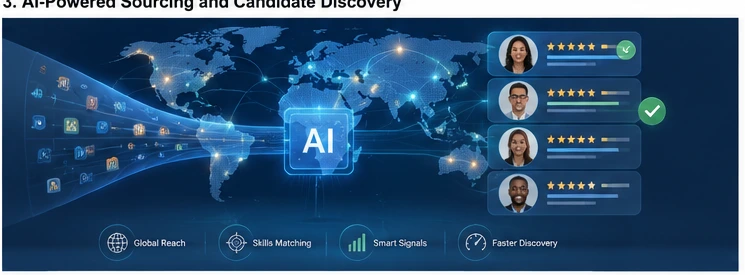
For companies hiring internationally specifically, this matters more than it might for a purely domestic search. A company looking for a software engineer, finance specialist, or salesperson is no longer boxed in by its home market’s talent pool. AI lets recruiters process much larger international candidate pools and focus human attention where it counts.
But there’s a catch I keep coming back to: if AI makes it easier to find candidates anywhere in the world, companies still need a scalable way to actually employ those candidates once they’re hired. Sourcing globally and employing globally are two different problems.
AI-Assisted Screening and Assessment
AI can compare applications against job requirements, flag relevant skills, summarize candidate profiles, and support early-stage assessments. What it shouldn’t do is replace human judgment entirely—and the data backs that up. The World Economic Forum has specifically flagged human oversight as critical in areas like communication and cultural fit, and SHRM’s research shows AI is mainly driving efficiency gains rather than removing humans from the loop: 89% of HR professionals report time savings, while 24% say it’s improved their ability to identify top candidates.
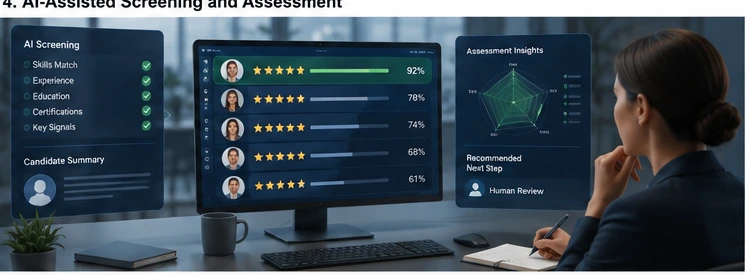
The realistic model here: AI absorbs more of the repetitive information-processing work, while humans stay responsible for judgment, context, and the final call. That distinction gets sharper the moment the candidate is based in another country, because the recruiting system itself won’t answer:
- Should this person be an employee or an independent contractor?
- Which country’s employment rules apply?
- What does the employment contract need to include?
- How should payroll and statutory contributions be handled?
- What benefits are legally required?
- Who manages the relationship after day one?
Those questions belong to a different layer entirely—and it’s the layer most AI-hiring content conveniently skips.
Where AI Hiring Tools Stop
This is the handoff point in the modern hiring workflow, and it’s the core of what I mean by AI hiring compliance. AI can make candidate discovery and evaluation dramatically faster, but speed doesn’t remove the legal and administrative requirements that kick in the moment someone accepts an offer.
If anything, the better AI gets at global recruiting, the more this gap matters. A company can use AI today to identify a strong engineer in another country in a single afternoon. But before that engineer starts, the company still needs the right employment structure in place, and after they start, someone still has to run payroll, manage benefits, handle taxes, and stay on top of compliance as local laws change.
AI answers, “Who should we hire?” Employment infrastructure answers, “How do we employ them correctly?” That’s the exact point where the AI hiring stack stops being about hiring intelligence and starts being about employment infrastructure.
The Infrastructure Layer: Employment, Payroll & Compliance
Once AI has helped a company identify and evaluate the right candidate, the nature of the hiring problem changes.
The question is no longer simply who to hire. It becomes how to establish, manage, and maintain the employment relationship in the country where that person will work.
For domestic hiring, many companies already have the infrastructure to handle this process. Cross-border hiring is different. Employment rules, worker classification, payroll obligations, statutory benefits, and tax requirements can vary significantly from one jurisdiction to another.
That is why the employment infrastructure layer matters. It turns an AI-assisted hiring decision into an operational employment relationship that can be managed over time.
Worker Classification: Employee or Contractor?
One of the first questions a company must answer after selecting an international worker is whether that person should be engaged as an employee or an independent contractor.
The distinction is not simply a matter of what the company calls the relationship. Depending on the jurisdiction, authorities may consider factors such as the degree of control over the worker, the nature of the relationship, financial arrangements, and how the work is performed.
This creates a particular challenge for companies that use AI to expand their contractor networks quickly. A recruiting system may identify an experienced professional in another country and make it easy to start a conversation, but it does not determine whether the resulting working relationship satisfies local classification rules.
Misclassification can create exposure to back taxes, social contributions, employment benefits, penalties, and disputes over worker rights. The consequences can also extend to intellectual property and the enforceability of agreements, depending on the jurisdiction and circumstances.
For companies hiring internationally, classification therefore needs to be treated as an employment decision rather than an administrative checkbox.
Before engaging a worker as a contractor, companies should consider questions such as:
- How much control does the company exercise over the worker?
- How independent is the worker in determining how the work is performed?
- Does the worker provide services to multiple clients?
- How integrated is the worker into the company’s core operations?
- Which classification rules apply in the worker’s country?
There is no universal global test that turns a fixed number of answers into an automatic classification. The relationship needs to be assessed under the applicable local rules.
This is one reason worker classification becomes increasingly important as AI makes it easier for companies to recruit talent across borders.
Local Employment & Contracts
Once a company determines that a worker should be employed rather than engaged as an independent contractor, the next challenge is establishing the employment relationship correctly.
An employment agreement is more than a document containing a salary and job title. Local employment requirements can affect working hours, leave, notice periods, termination procedures, mandatory benefits, probation periods, and other terms of employment.
A contract that works for an employee in one country may not be appropriate for an employee in another.
This becomes particularly difficult for companies expanding into multiple markets. Instead of maintaining one standardized employment process, employers need to account for the requirements of each jurisdiction where their employees are located.
For a growing international team, that means the employment infrastructure needs to handle more than simply generating a contract. It needs to support locally appropriate employment documentation and keep the relationship aligned with applicable requirements as circumstances change.
Global Payroll & Taxes
After the employment relationship is established, the company needs a reliable way to pay the worker and manage the associated payroll obligations.
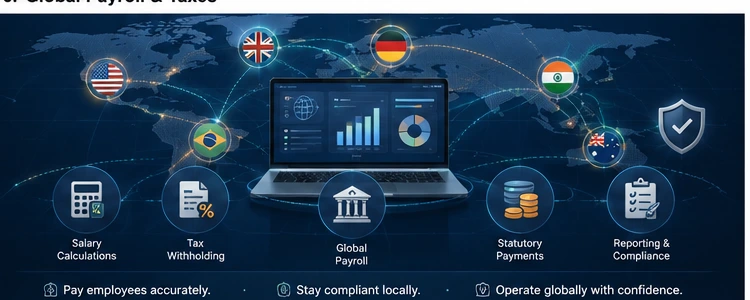
Global payroll can involve salary calculations, deductions, employer contributions, statutory payments, tax withholding, reporting, and different payment schedules depending on the country.
This is another area where the speed of AI recruiting does not eliminate operational complexity.
A company can identify and hire an employee in another country in a matter of days, but payroll still needs to work correctly every pay period.
Errors in payroll can affect employees directly while also creating financial and compliance issues for the employer. Companies therefore need processes capable of handling local payroll requirements rather than assuming that a domestic payroll workflow can simply be copied into another market.
For organizations hiring across several countries, centralizing payroll administration can also make it easier to maintain visibility over international employment costs and obligations.
Benefits & Employment Administration
Employment does not end with the first successful payroll run.
Employees may be entitled to statutory benefits, paid leave, insurance, pension or social security contributions, and other employment protections depending on where they work.
Companies also need processes for onboarding, maintaining employee records, managing changes to employment terms, administering leave, and eventually handling offboarding.
This is particularly important for remote and distributed teams because employees in different countries can have very different statutory requirements.
An effective global employment infrastructure therefore needs to support the entire employee lifecycle rather than focusing only on the moment of hiring.
Ongoing Compliance: The Responsibility Doesn’t End on Day One
One of the easiest mistakes to make when thinking about global hiring is treating compliance as a one-time task.
Employment relationships continue for months or years, while laws, tax requirements, benefits rules, and employment regulations can change.
A company that was compliant when an employee was hired still needs to remain compliant as the employment relationship evolves.
This means global employment infrastructure needs to support ongoing processes such as payroll, statutory contributions, benefits administration, employment documentation, and changes to local requirements.
The more countries a company operates in, the harder it becomes to manage these obligations manually.
This is where the distinction between the AI layer and the employment infrastructure layer becomes particularly important.
AI can make the front end of global hiring faster. Employment infrastructure makes the back end manageable.
And for companies that want to turn an increasingly global talent strategy into a sustainable operating model, both layers need to work together.
Where Deel Fits Into the AI Hiring Stack
AI can make global recruiting faster, but companies still need an operational layer between the hiring decision and the employee’s day-to-day employment.
That is where an Employer of Record (EOR) can fit into the modern hiring stack.
Instead of building a separate employment infrastructure for every country where the company wants to hire, an EOR can provide a framework for employing workers in supported jurisdictions while helping manage employment administration, payroll, and local compliance requirements.
From AI-Assisted Hiring to Compliant Employment
The distinction becomes clearer when the entire hiring journey is viewed as one workflow.
AI-powered recruiting tools can help a company move from a hiring need to a shortlist of qualified candidates:
- Identify potential talent
- Screen and compare candidates
- Match skills to the requirements of the role
- Support early-stage assessments
- Help recruiters make more informed decisions
Once the company selects a candidate, however, the workflow changes.
The company now needs to establish the employment relationship, prepare the appropriate documentation, manage payroll and statutory requirements, administer benefits, and maintain compliance throughout the employee lifecycle.
This is the point where an EOR can become part of the infrastructure.
The result is not an AI-versus-EOR model. It is a connected workflow:
AI helps companies find and evaluate talent. An EOR can help companies employ and manage that talent across borders.
Deel as the Employment Infrastructure Layer
Deel positions its platform around global employment, payroll, and compliance, making it relevant to companies that want to build distributed teams without creating an independent employment infrastructure in every market.
For an AI-driven hiring strategy, this creates a natural division of responsibilities.
The AI layer handles more of the intelligence and efficiency at the front of the funnel.
The employment layer handles the operational requirements that begin once a company decides to hire.
Deel’s EOR model is designed to allow companies to hire employees through an EOR in countries where they do not have their own legal entity, while Deel handles employment-related administration in the relevant jurisdiction.
This can be particularly useful for companies testing new international markets or hiring specialized talent in countries where establishing a local entity would add significant administrative overhead.
It also changes the economics of global expansion. Instead of treating every new country as a decision to establish a permanent local infrastructure, companies can use an EOR model when it fits their hiring strategy and circumstances.
What This Means for Companies Hiring Globally
The biggest advantage of combining AI-powered recruiting with employment infrastructure is not simply speed. It is the ability to connect speed with operational readiness.
Imagine a company using AI to identify a highly qualified engineer in Germany, a sales specialist in the United Kingdom, or a finance professional in the United Arab Emirates.
The recruiting side of the process can now move quickly.
But each hire still creates a separate set of employment considerations.
With an EOR model, the company can potentially move from identifying international talent to employing that talent without first building its own legal entity in every country involved.
That can make the hiring strategy more flexible, particularly for companies that are entering new markets, building distributed teams, or hiring specialized talent internationally.
However, an EOR should not be viewed as a replacement for every aspect of HR, legal, or recruiting. Companies still need to make appropriate hiring decisions, understand their workforce, provide accurate information, and follow the applicable requirements for their specific situation.
The EOR becomes the employment infrastructure that connects the recruiting decision to the ongoing employment relationship.
In other words, AI can shorten the distance between “we need this talent” and “we found this talent.” An employment infrastructure layer helps shorten the distance between “we found this talent” and “we can employ this person properly.
The New Global Hiring Workflow
The future of global hiring is not about choosing between AI and employment infrastructure. It is about connecting the two.
AI can accelerate the front end of the hiring process, helping companies discover and evaluate talent faster. Employment infrastructure takes over when that hiring decision becomes an actual employment relationship.
The complete workflow can, therefore, be viewed as the following:
AI → Candidate Discovery → Screening & Assessment → Hiring Decision → Employment Infrastructure → Payroll & Benefits → Ongoing Compliance
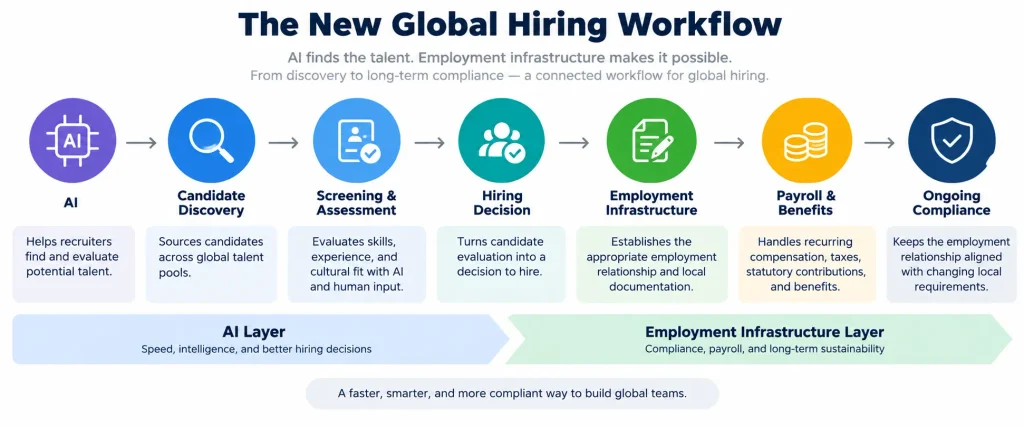
Each stage has a different purpose.
- AI: helps recruiters find and evaluate potential talent.
- Hiring decision: Turns candidate evaluation into a decision to hire.
- Employment infrastructure: Establishes the appropriate employment relationship and local documentation.
- Payroll & benefits: Handles recurring compensation and employment-related obligations.
- Ongoing compliance: Keeps the employment relationship aligned with changing local requirements.
The important shift is that global hiring is becoming less of a single recruiting process and more of an interconnected system.
Companies can use AI to expand their search for talent beyond their home markets, but the operational infrastructure behind those hires needs to scale with the same ambition.
Conclusion: AI Makes Global Hiring Faster. Compliance Makes It Sustainable.
AI is changing how companies find and evaluate talent. Recruiting teams can search larger talent pools, automate repetitive tasks, and move qualified candidates through the hiring funnel faster than traditional processes allowed.
But faster hiring does not eliminate the responsibilities that begin when someone accepts an offer.
Worker classification, local employment requirements, payroll, taxes, benefits, and ongoing compliance remain critical parts of employing people across borders.
That is why the most effective global hiring strategy in 2026 is not simply an AI-powered recruiting stack. It is an AI-powered recruiting stack connected to reliable employment infrastructure.
AI helps you find the talent. The right employment infrastructure helps you turn that talent into a sustainable global team.
Ready to Build a More Scalable Global Hiring Process?
If your company is using AI to expand its talent search internationally, the next step is making sure the employment side of that strategy can scale with it.
Deel provides EOR, global payroll, and employment infrastructure designed to help companies hire and manage workers internationally without having to build their own employment infrastructure in every market. Deel says its EOR solution supports hiring without requiring the customer to establish a local entity, while its platform handles employment administration, payroll, and localized requirements in supported countries.
If you’re exploring international hiring or testing a new market, you can learn more about how Deel’s global employment platform works here:
Explore Deel for Global Hiring
Affiliate Disclosure
This article contains an affiliate link. If you sign up for Deel through my link, I may receive a commission at no additional cost to you. I only recommend services that are relevant to the global hiring, payroll, and compliance challenges discussed in this guide.

James B. has 8 years of experience in online business and digital publishing. At EarnGoGo, he researches and writes about HR, payroll, global employment, and employment compliance, focusing on how technology and AI are changing the way companies hire and manage international teams.