If you plan to hire employees in Algeria, understanding the country’s employment laws, payroll requirements, tax obligations, and compliance rules is essential. Algeria is becoming an increasingly attractive destination for international companies seeking skilled talent, competitive labor costs, and strong alignment with European business hours. As remote work continues to reshape the global workforce, Algeria has emerged as a promising destination for businesses seeking to expand their teams without the high costs of many Western markets.
However, hiring in Algeria involves more than simply finding qualified candidates. Employers must understand local labor laws, employment contracts, payroll obligations, social security contributions, tax requirements, and compliance regulations. Failing to meet these obligations can expose companies to financial penalties, legal disputes, and operational risks.
Whether you plan to hire software developers, customer support representatives, marketing specialists, finance professionals, or other remote employees, understanding the legal and administrative framework is essential for long-term success.
In this guide, you’ll learn:
- Best practices for building a compliant workforce in Algeria
- How to hire employees in Algeria legally
- Key employment laws and compliance requirements
- Payroll, taxes, and social security obligations
- Employee vs. contractor classification rules
- Employer of Record (EOR) options
Why Companies Are Hiring in Algeria
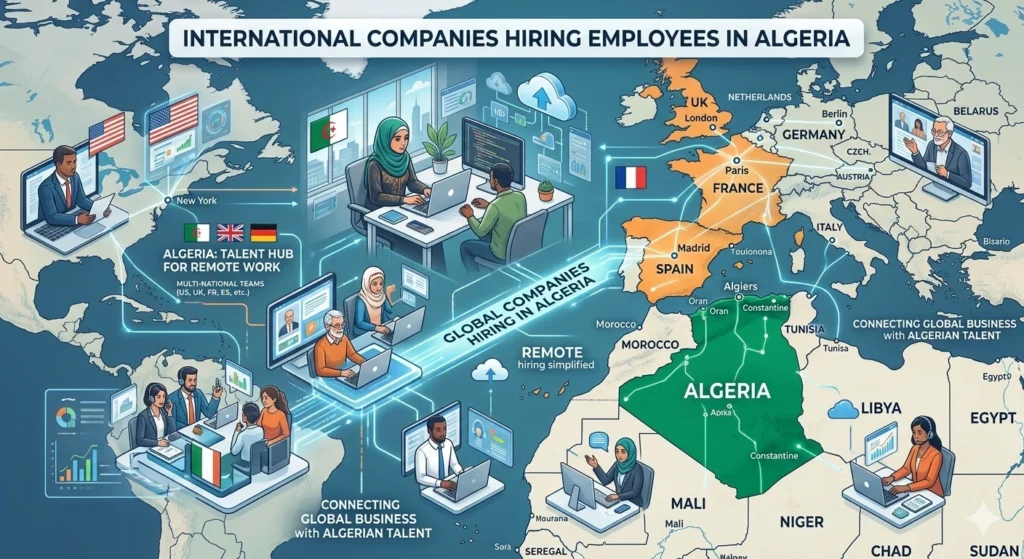
As global companies continue expanding their remote and distributed teams, hiring in Algeria is becoming an increasingly attractive option. Companies looking to hire employees in Algeria can benefit from a highly educated workforce, strong alignment with European business hours, and competitive labor costs. These advantages make Algeria a compelling destination for organizations seeking to scale internationally.
Whether you are hiring software engineers, customer support specialists, marketers, finance professionals, or operations staff, Algerian talent provides access to high-quality skills without the overhead costs associated with many Western markets.
Here are the key reasons why international employers are increasingly hiring in Algeria.
1. Access to a Skilled and Educated Workforce
Algeria has one of the largest populations in Africa, supported by a young workforce and a strong emphasis on higher education. Every year, universities and technical institutions produce thousands of graduates in engineering, information technology, finance, business administration, and data science.
Many professionals are fluent in both Arabic and French, while English proficiency continues to improve, particularly among younger professionals working in technology and digital industries. This multilingual advantage allows Algerian employees to collaborate effectively with international teams and support customers across multiple markets.
2. Strong Time Zone Alignment with Europe
One of Algeria’s greatest advantages is its location in the Central European Time zone (CET/GMT+1).
For companies based in the United Kingdom, France, Germany, Spain, the Netherlands, and other European countries, this creates significant operational benefits. Teams can collaborate in real time, attend meetings without scheduling conflicts, and maintain efficient communication throughout the workday.
Unlike hiring in regions with significant time differences, employers can build highly productive teams without relying heavily on asynchronous communication.
3. Cost-Effective International Hiring
Algeria offers employers access to qualified professionals at highly competitive salary levels compared to many Western European and North American markets.
This enables businesses to scale efficiently while maintaining quality standards and controlling payroll costs. At the same time, international employers can provide compensation packages that are highly attractive within the local market, helping improve retention and employee satisfaction.
For startups and growing companies, this cost efficiency can make international expansion significantly more sustainable.
4. Growing Adoption of Remote Work
Remote work has become increasingly common among Algerian professionals. Many employees already work with international companies, global startups, and distributed teams across Europe, North America, and the Middle East.
As a result, employers gain access to talent familiar with remote collaboration tools, digital workflows, and cross-border communication practices. This often reduces onboarding friction and helps new hires integrate more quickly into global organizations.
5. A Strategic Gateway to North Africa
For companies expanding into North African and French-speaking markets, Algeria represents a strategic location. Its large population, regional influence, and strong French-language capabilities make it an attractive base for customer support, business operations, and regional growth initiatives.
Organizations looking to establish a long-term presence in the region often view Algeria not only as a source of talent but also as an important market for future expansion.
Employment Laws in Algeria: What Employers Need to Know
Before hiring employees in Algeria, international companies should understand the country’s labor framework and employer obligations. Algerian employment relationships are primarily governed by labor laws that protect employee rights and establish clear responsibilities for employers.
Whether you hire directly through a local entity or use an Employer of Record (EOR), compliance with local employment regulations is essential. Failure to comply with labor laws can result in financial penalties, legal disputes, and administrative complications.
Some of the most important areas employers should understand include:
- Employment contract requirements
- Working hours and overtime regulations
- Paid leave and public holidays
- Social security contributions
- Employee termination procedures
- Worker classification rules
Unlike some jurisdictions where employment terms can be highly flexible, Algerian labor regulations provide employees with significant legal protections. Employers should therefore ensure that contracts, payroll processes, and workplace policies are aligned with local requirements from the beginning.
For foreign companies, navigating these requirements can be challenging without local expertise. This is one of the reasons many global employers choose to work with an Employer of Record when hiring in Algeria.
For companies looking to hire employees in Algeria, understanding these requirements is critical before making a job offer or signing an employment contract. Employers must ensure that hiring practices, payroll administration, employee benefits, and termination procedures comply with Algerian labor laws to avoid potential compliance risks.
The following sections outline the key legal considerations every global employer should understand before hiring in Algeria.
Employment Contracts in Algeria
Employment contracts form the foundation of the employer-employee relationship in Algeria. To ensure compliance with Algerian labor laws, employers should provide clear written agreements that define the rights and obligations of both parties.
A typical employment contract in Algeria should include the following:
- Job title and responsibilities
- Employee compensation and payment terms
- Working hours and schedule
- Contract duration (fixed-term or indefinite-term)
- Probation period, if applicable
- Notice periods and termination conditions
- Applicable benefits and leave entitlements
Fixed-Term vs. Indefinite-Term Contracts
Employers hiring in Algeria generally have two primary contract options:
Fixed-Term Contracts (CDD)
Fixed-term contracts are used for temporary assignments, project-based work, seasonal activities, or specific business needs with a defined end date.
These contracts should clearly specify the duration of employment and the circumstances under which the contract will end.
Indefinite-Term Contracts (CDI)
Indefinite-term contracts are considered the standard form of employment in many situations and provide greater long-term stability for employees.
For companies planning to build a permanent team in Algeria, indefinite-term contracts are often the preferred option.
Probation Periods
Employers may include a probation period to evaluate whether an employee is suitable for the role. During this period, both parties can assess the employment relationship before making a long-term commitment.
The specific duration and conditions of probation should be clearly outlined in the employment contract and comply with applicable labor regulations.
Why Proper Contracts Matter
For international employers, properly drafted employment contracts help reduce compliance risks and establish clear expectations from the start.
Whether hiring directly through a local entity or using an Employer of Record (EOR), ensuring that contracts align with Algerian labor requirements is an important step toward building a compliant workforce.
Employee vs. Contractor Classification in Algeria
One of the most important decisions international companies must make when they hire employees in Algeria is determining whether a worker should be classified as an employee or an independent contractor.
While hiring contractors may appear simpler and more cost-effective, misclassifying workers can create significant compliance risks. Algerian labor regulations, like those in many countries, focus on the actual nature of the working relationship rather than the title assigned to the worker.
Employees
Employees typically work under the direction and control of an employer. They generally follow established working schedules, use company resources, and perform services that are integrated into the company’s core business operations.
When hiring employees in Algeria, employers are generally responsible for:
- Employment contracts
- Payroll administration
- Social security contributions
- Tax withholding obligations
- Mandatory employee benefits
- Compliance with local labor laws
Independent Contractors
Independent contractors generally operate as self-employed professionals who provide services to multiple clients and maintain greater control over how their work is performed.
Companies often engage contractors for:
- Project-based assignments
- Specialized consulting services
- Temporary business needs
- Short-term engagements
However, simply labeling a worker as a contractor does not automatically make the classification compliant.
Risks of Worker Misclassification
Misclassification occurs when a worker is treated as an independent contractor while functioning as an employee under local labor standards.
Potential consequences may include:
- Unpaid taxes and social contributions
- Employment-related claims
- Financial penalties
- Legal disputes
- Retroactive benefit obligations
For this reason, companies planning to hire employees in Algeria should carefully assess each working relationship before deciding on a classification model.
Employee or Contractor: Which Is Right for Your Business?
The correct approach depends on the nature of the role, the level of supervision involved, the duration of the engagement, and the worker’s independence.
Many international employers choose to work with local legal experts or Employer of Record (EOR) providers to reduce classification risks and ensure compliance when expanding into Algeria.
Working Hours and Overtime in Algeria
Companies planning to hire employees in Algeria should understand the country’s working time regulations to ensure compliance with local labor requirements.
Standard working hours in Algeria are generally set at 40 hours per week, typically distributed as 8 hours per day across five working days. In many organizations, the standard workweek runs from Sunday to Thursday, while Friday and Saturday are generally observed as weekend days. However, specific schedules may vary depending on the industry, collective agreements, and the nature of the work being performed.
Employers should clearly define working schedules within employment contracts and company policies to avoid misunderstandings and compliance issues.
Overtime Regulations
In certain situations, employees may be required to work beyond their standard working hours. When overtime is necessary, employers should ensure that it complies with applicable labor regulations and compensation requirements.
When employees work beyond the standard 40-hour workweek, overtime compensation may apply. In many cases, overtime work is compensated at a premium rate that can reach 150% of the employee’s regular hourly wage, depending on the circumstances and applicable labor requirements.
Proper documentation of overtime hours is important for both payroll accuracy and legal compliance. Companies should maintain clear records of employee working hours, overtime arrangements, and compensation practices.
Rest Periods and Weekly Time Off
Employees are generally entitled to adequate rest periods and weekly time off. Employers should ensure that work schedules allow employees to receive the required rest periods in accordance with local labor standards.
For international employers managing remote teams, establishing transparent attendance and time-tracking policies can help maintain compliance while supporting employee productivity and well-being.
Why Working Time Compliance Matters
When companies hire employees in Algeria, compliance extends beyond contracts and payroll. Working hours, overtime practices, and employee scheduling can all impact labor law compliance.
Implementing clear policies from the beginning helps reduce disputes, improve employee satisfaction, and support a legally compliant employment relationship.
In addition to working time regulations, employers should also consider annual leave entitlements, public holidays, and local scheduling practices when managing employees in Algeria.
Payroll and Social Security Contributions in Algeria
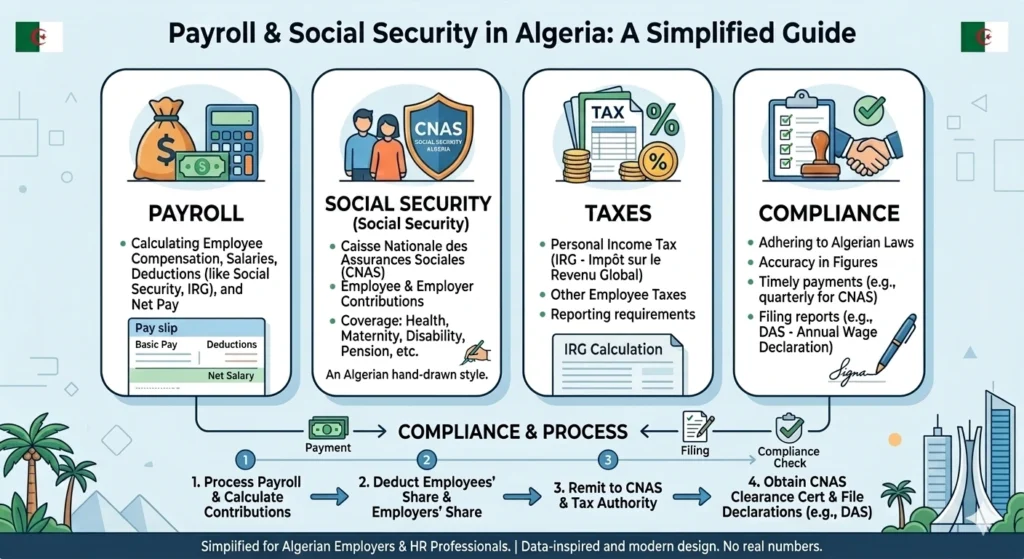
Managing payroll is one of the most important compliance responsibilities for companies that hire employees in Algeria. Employers must ensure that salaries, social security contributions, and payroll records are handled in accordance with local regulations.
Failure to comply with payroll obligations can expose businesses to financial penalties, administrative complications, and employment-related disputes.
Payroll Requirements
Employers hiring in Algeria are generally responsible for calculating employee compensation, processing payroll accurately, maintaining employment records, and ensuring that all mandatory deductions are applied correctly.
Payroll processes should include:
- Employee salary calculations
- Overtime compensation
- Mandatory deductions
- Social security contributions
- Income tax withholding
- Payroll record maintenance
Employers should also be aware of Algeria’s National Minimum Wage (SNMG), which is currently set at 24,000 DZD per month. Compensation packages should always comply with applicable minimum wage requirements and local employment regulations.
For international companies, payroll compliance can become particularly challenging when managing employees remotely without local expertise.
CNAS Contributions
Employees in Algeria are generally covered by the National Social Insurance Fund (CNAS), which provides access to social protection programs, including healthcare coverage, workplace injury protection, maternity benefits, and certain retirement-related benefits.
As a general reference, employer social security contributions can represent approximately 26% of an employee’s gross salary, while employee contributions are typically around 9%. Combined, the total social security burden may reach approximately 35% of gross compensation.
Employers are typically responsible for registering eligible employees and ensuring that required social security contributions are reported and paid in accordance with local requirements.
CASNOS and Independent Workers
Independent contractors and self-employed professionals are generally associated with CASNOS (National Social Security Fund for Non-Salaried Workers) rather than CNAS.
This distinction is important for international employers when determining whether a worker should be classified as an employee or an independent contractor.
Worker classification decisions can directly affect payroll obligations, social contributions, and overall compliance requirements.
Why Payroll Compliance Matters
Companies that hire employees in Algeria should establish compliant payroll processes from the beginning. Accurate payroll administration not only helps meet legal obligations but also improves employee trust and operational efficiency.
Many international employers choose to work with local payroll specialists or Employer of Record (EOR) providers to simplify payroll management and reduce compliance risks when expanding into Algeria.
Taxes and Income Tax (IRG) in Algeria
In addition to payroll and social security obligations, companies that hire employees in Algeria must also consider income tax compliance.
Employee income in Algeria is generally subject to IRG (Impôt sur le Revenu Global), which serves as the country’s personal income tax system. Employers are typically responsible for withholding the appropriate tax amounts from employee salaries and ensuring that payroll calculations comply with applicable tax requirements.
Employer Tax Responsibilities
When hiring employees in Algeria, employers are generally expected to:
- Calculate taxable compensation accurately
- Apply mandatory payroll deductions
- Withhold applicable income taxes
- Maintain payroll and tax records
- Comply with reporting requirements
Accurate payroll administration is essential because errors in tax calculations can create compliance issues and administrative burdens for both employers and employees.
Tax Compliance for International Employers
Foreign companies expanding into Algeria often face additional challenges when managing payroll taxes remotely. Understanding local requirements, maintaining proper records, and keeping payroll processes compliant can require significant administrative effort.
As businesses grow and hire more employees in Algeria, these obligations become increasingly important to manage correctly.
Reducing Payroll and Tax Complexity
Many international employers choose to work with local payroll experts or Employer of Record (EOR) providers to simplify payroll administration, tax withholding, and compliance management.
This approach can help reduce operational complexity while ensuring that employees are paid accurately and in accordance with local regulations.
Employee Benefits in Algeria
Companies that hire employees in Algeria should understand that compensation extends beyond base salary. Employers are generally expected to provide employees with access to mandatory protections and benefits established under local labor and social security regulations.
Employee benefits play an important role in attracting talent, supporting workforce stability, and maintaining compliance with employment requirements.
Healthcare and Social Protection
Through the Algerian social security system, eligible employees may receive access to healthcare coverage and various social protection programs. These protections are typically linked to employer and employee social security contributions.
Maternity and Family-Related Benefits
Employees may be entitled to certain maternity-related protections and benefits under applicable labor and social security regulations. Employers should ensure that workplace policies comply with local legal requirements regarding family-related leave and employee protections.
Retirement-Related Contributions
Social security contributions made during employment help support retirement-related programs and long-term social protection mechanisms available to eligible workers.
Workplace Protection and Employee Security
Employment regulations in Algeria are designed to provide workers with a degree of legal protection regarding working conditions, compensation, and employment rights. Employers should ensure that contracts, policies, and payroll practices remain aligned with these requirements.
Why Benefits Matter for Employers
When companies hire employees in Algeria, benefits should be viewed as part of the overall employment package rather than as a separate administrative obligation.
A competitive and compliant benefits structure can improve employee satisfaction, strengthen retention, and help international employers attract qualified talent in an increasingly competitive labor market.
Annual Leave and Public Holidays in Algeria
Companies that hire employees in Algeria should understand local leave entitlements and public holiday requirements when planning workforce schedules and payroll operations.
Properly managing leave policies helps maintain compliance while ensuring employees receive the benefits and time off provided under local employment regulations.
Annual Leave Entitlements
Employees in Algeria are generally entitled to paid annual leave. The exact entitlement may vary depending on factors such as length of service, employment conditions, and applicable labor regulations.
As a general rule, employees are entitled to approximately 30 calendar days of paid annual leave per year, accrued at a rate of roughly 2.5 days per month worked. Employers should ensure that leave policies are documented clearly and administered consistently.
Annual leave should be clearly documented within company policies and employment agreements. Employers should also establish procedures for leave requests, approvals, and payroll administration during periods of absence.
Weekly Rest Days
Unlike many Western countries, where weekends typically fall on Saturday and Sunday, the standard weekend in Algeria generally consists of
- Friday
- Saturday
International employers managing distributed teams should take local scheduling practices into account when planning meetings, project deadlines, and team collaboration activities.
Public Holidays in Algeria
Employers should also be aware of Algeria’s official public holidays, which may include:
- New Year’s Day
- International Workers’ Day (May 1)
- Independence Day (July 5)
- Revolution Day (November 1)
- Eid al-Fitr
- Eid al-Adha
- Islamic New Year
- Ashura
- Mawlid al-Nabi
Because some religious holidays follow the Islamic lunar calendar, official dates may vary from year to year.
Why Leave Compliance Matters
When companies hire employees in Algeria, leave management should be treated as an important component of workforce compliance.
Clear policies regarding annual leave, public holidays, and scheduling expectations help reduce administrative issues, improve employee satisfaction, and support a positive employment experience.
Termination Rules and Compliance Risks in Algeria
Companies that hire employees in Algeria should understand that employment termination is often subject to specific legal requirements and employee protections.
Unlike independent contractor relationships, terminating an employment agreement may require employers to follow established procedures and maintain proper documentation. Failure to comply with applicable requirements can increase the risk of legal disputes and financial liabilities.
Employee Termination Considerations
Before ending an employment relationship, employers should carefully review:
- Employment contract terms
- Applicable labor regulations
- Notice requirements
- Employee rights and protections
- Documentation requirements
The specific circumstances surrounding a termination can significantly affect an employer’s legal obligations.
Compliance Risks for International Employers
Foreign companies that hire employees in Algeria without local expertise may face several compliance challenges, including:
- Worker misclassification
- Payroll and tax errors
- Incomplete employment documentation
- Improper termination procedures
- Social security compliance issues
Even small administrative mistakes can create unexpected legal and financial consequences.
Reducing Employment Risks
The most effective way to reduce compliance risks is to establish compliant employment processes from the beginning.
Clear contracts, accurate payroll administration, proper worker classification, and adherence to local labor regulations can help employers avoid disputes and support long-term workforce stability.
For international companies, local legal expertise or Employer of Record (EOR) solutions can help simplify compliance management and reduce operational risk when expanding into Algeria.
Algeria Employment Overview
The following table provides a quick overview of some of the most important employment, payroll, and workforce considerations for companies planning to hire employees in Algeria.
| Employment Factor | Algeria |
| Currency | Algerian Dinar (DZD) |
| Standard Workweek | 40 Hours |
| Weekend Days | Friday & Saturday |
| Minimum Wage (SNMG) | 24,000 DZD |
| Employer CNAS Contribution | 26% |
| Employee CNAS Contribution | 9% |
| Annual Leave | 30 Calendar Days |
| Main Languages | Arabic, French |
| Time Zone | GMT+1 |
Entity vs. Employer of Record (EOR) in Algeria
One of the biggest decisions international companies face when they hire employees in Algeria is determining how they will legally employ and manage their workforce.
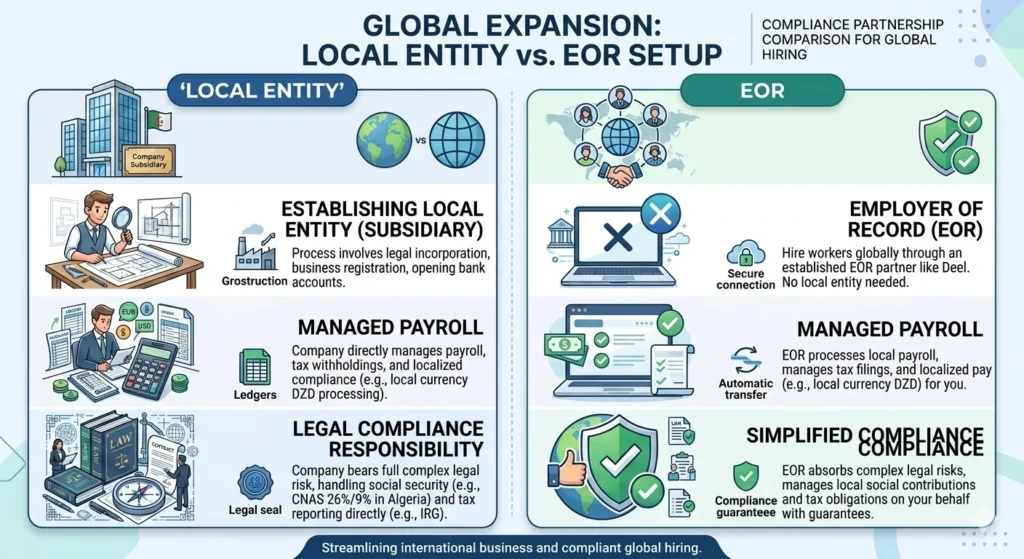
In most cases, businesses have two primary options:
- Establish a local legal entity in Algeria.
- Partner with an Employer of Record (EOR).
The right approach depends on a company’s growth strategy, hiring plans, budget, and compliance requirements.
Option 1: Establishing a Local Entity
Creating a local entity allows a company to hire employees directly and maintain full control over employment operations.
However, establishing and managing a local entity can require significant time, resources, and ongoing administrative effort.
Companies may need to handle:
- Business registration requirements
- Local employment contracts
- Payroll administration
- Tax compliance
- Social security obligations
- Ongoing legal and regulatory requirements
For organizations planning substantial long-term operations in Algeria, establishing a local entity may be a viable option.
Option 2: Using an Employer of Record (EOR)
An Employer of Record (EOR) acts as the legal employer on behalf of a foreign company while the employee performs work for the client organization.
This approach allows companies to hire employees in Algeria without establishing their own local legal entity.
An EOR typically helps manage:
- Employment contracts
- Payroll administration
- Tax withholding
- Social security compliance
- Employee onboarding
- Local labor law compliance
This can significantly reduce administrative complexity and accelerate international hiring.
Which Option Is Best?
For companies planning to hire only a small number of employees in Algeria, an Employer of Record is often the fastest and most cost-effective option.
For organizations building a large local presence with long-term operational requirements, establishing a local entity may eventually make strategic sense.
The most appropriate solution depends on hiring volume, growth plans, compliance considerations, and available internal resources.
How Deel Helps Companies Hire Employees in Algeria
For many international businesses, the biggest challenge is not finding talent in Algeria—it’s managing contracts, payroll, compliance, and ongoing employment obligations without establishing a local entity.
This is where Deel can help.
As a global hiring and payroll platform, Deel enables companies to hire employees in Algeria while simplifying many of the administrative and compliance challenges associated with international employment.
Localized Employment Contracts
Employment laws vary significantly from one country to another. Deel helps businesses generate and manage localized employment agreements designed to align with local requirements and employment standards.
This can help employers reduce compliance risks while ensuring employees receive contracts that reflect local labor practices.
Employer of Record (EOR) Services
Through its Employer of Record solution, Deel allows companies to hire employees in Algeria without establishing their own legal entity.
This enables organizations to expand into new markets more quickly while reducing the operational burden associated with international hiring.
Payroll Processing and Compliance Support
Managing payroll across multiple countries can become increasingly complex as teams grow.
Deel helps streamline payroll administration by supporting:
- Employee payroll processing
- Tax withholding requirements
- Social security compliance
- Payroll reporting
- Ongoing employment administration
This can help employers maintain compliance while improving payroll accuracy and operational efficiency.
Country-Specific Onboarding
Successful international hiring goes beyond contracts and payroll.
Deel supports onboarding processes designed to help companies integrate new hires efficiently while maintaining compliance with local employment requirements.
Contractor Management
For businesses working with independent professionals, Deel also provides contractor management solutions that help simplify payments, documentation, and workforce administration across multiple countries.
Why Companies Choose Deel for Hiring in Algeria
Companies that hire employees in Algeria often want to move quickly while minimizing compliance risks.
By combining Employer of Record services, payroll support, localized contracts, onboarding tools, and workforce management capabilities into a single platform, Deel can help businesses expand into Algeria with greater confidence and operational efficiency.
Conclusion
Algeria is becoming an increasingly attractive destination for international companies seeking skilled talent, competitive labor costs, and strong alignment with European business hours.
However, companies that hire employees in Algeria must also navigate employment contracts, worker classification rules, payroll administration, social security contributions, tax obligations, employee benefits, public holidays, and local compliance requirements.
For businesses planning long-term expansion, establishing a local entity may be an option. However, for many international employers, managing these obligations independently can create significant administrative and compliance challenges.
Hiring Employees in Algeria Without Establishing a Local Entity
If your company wants to hire employees in Algeria without opening a local legal entity, an Employer of Record (EOR) can help simplify the process.
Deel’s Employer of Record solution enables businesses to hire, onboard, pay, and manage employees in Algeria while helping maintain compliance with local employment requirements.
Whether you’re hiring your first employee in Algeria or expanding an existing global workforce, using an EOR can help reduce complexity, accelerate hiring, and support compliant international growth.
👉 Explore Deel’s Employer of Record solution to hire employees in Algeria without setting up a local entity and start building your team with confidence.
Frequently Asked Questions (FAQ)
Can a foreign company hire employees in Algeria?
Yes. Foreign companies can hire employees in Algeria either by establishing a local legal entity or by working with an Employer of Record (EOR). Many international employers choose an EOR solution to simplify compliance, payroll, and employment administration.
Do I need a legal entity to hire employees in Algeria?
Not necessarily. Companies can hire employees in Algeria through an Employer of Record (EOR), which acts as the legal employer on behalf of the foreign company while managing local employment requirements.
What is the difference between an employee and an independent contractor in Algeria?
Employees typically work under the direction and control of an employer and are entitled to employment protections, payroll administration, and social security coverage. Independent contractors generally operate with greater independence and manage their own business activities and obligations.
What payroll obligations should employers consider in Algeria?
Companies that hire employees in Algeria should consider payroll processing, social security contributions, income tax withholding (IRG), payroll record maintenance, and compliance with local employment regulations.
What is CNAS in Algeria?
CNAS (National Social Insurance Fund) is the primary social security system for salaried employees in Algeria. It provides access to healthcare coverage and various social protection benefits funded through employer and employee contributions.
What is CASNOS in Algeria?
CASNOS (National Social Security Fund for Non-Salaried Workers) is the social security system generally associated with self-employed professionals and independent workers in Algeria.
What public holidays should employers be aware of in Algeria?
Employers should consider national and religious holidays such as International Workers’ Day, Independence Day, Revolution Day, Eid al-Fitr, Eid al-Adha, Islamic New Year, Ashura, and Mawlid al-Nabi when planning workforce schedules.
How can an Employer of Record help companies hire employees in Algeria?
An Employer of Record (EOR) can help companies hire employees in Algeria without establishing a local entity. EOR providers typically assist with employment contracts, onboarding, payroll administration, tax compliance, social security obligations, and ongoing employment management.
Is Algeria a good location for remote hiring?
Yes. Algeria offers access to a skilled and multilingual workforce, strong alignment with European business hours, and competitive hiring costs, making it an attractive market for international employers and remote teams.
Resources
The following resources may be useful for employers seeking additional information about employment laws, payroll requirements, social security contributions, and workforce compliance in Algeria.
- National Social Insurance Fund (CNAS)
- National Social Security Fund for Non-Salaried Workers (CASNOS)
- Algerian Ministry of Labour, Employment and Social Security
- International Labour Organization (ILO) – Algeria Labour Resources
- PwC Algeria Tax Summary

James B. has 8 years of experience in online business and digital publishing. At EarnGoGo, he researches and writes about HR, payroll, global employment, and employment compliance, focusing on how technology and AI are changing the way companies hire and manage international teams.