
Global expansion can open the door to new markets, customers, and talent. But for growing companies, hiring internationally can also introduce a costly compliance risk that is often overlooked: employee misclassification.
Employee misclassification occurs when a worker is incorrectly classified as an independent contractor instead of an employee, potentially exposing a company to back taxes, penalties, benefits claims, and other legal costs. The risk becomes even more complex when workers operate across different countries and employment systems, each with its own rules and employment protections.
As companies scale, what starts with one contractor can quickly become a distributed workforce across multiple jurisdictions. Without the right compliance processes, a classification decision made at the beginning of a working relationship can become an expensive problem later.
In this guide, we’ll examine the hidden costs of employee misclassification, why growing companies get it wrong, the warning signs to watch for, and how an Employer of Record (EOR) can help businesses build compliant international teams without taking on unnecessary legal and administrative complexity.
What Is Employee Misclassification?
Employee misclassification occurs when a company incorrectly classifies a worker as an independent contractor or self-employed person when, under the applicable law, the relationship should be treated as employment.
The distinction is important because an employee and an independent contractor can carry very different tax obligations, employment rights, and responsibilities for the business. When a worker is incorrectly classified, the company may later face claims for unpaid taxes, employment benefits, penalties, or other liabilities.
However, there is no single global test for determining whether someone is an employee or an independent contractor. The actual working relationship generally determines employment status, and the relevant factors can vary by jurisdiction.
In the United States, for example, the IRS looks at the degree of control and independence between the business and the worker. Its analysis considers factors such as behavioral control, financial control, and the nature of the relationship between the parties.
GOV.UK states that employment status affects both a worker’s rights and an employer’s responsibilities and that employment status may differ between employment law and tax law. The classification should reflect the reality of the working relationship rather than simply the label chosen by the parties.
This means that calling someone a “contractor” in an agreement does not automatically make them one. The IRS explains that a contract stating that a worker is an independent contractor is not sufficient by itself to determine the worker’s status. If the company controls how the person works, expects them to perform the work personally, provides the tools or equipment, or otherwise treats the person like an employee, those facts may matter when authorities assess the relationship.
For companies hiring internationally, the challenge becomes even more complicated. A worker who appears to fit the definition of a contractor from a business perspective may still be considered an employee under the laws of the country where they work. That is where employee misclassification becomes more than an HR issue. It can become a tax, payroll, employment-law, and financial risk.
Why Do Companies Misclassify Employees?
Misclassification rarely begins with malicious intent. In high-growth companies, it often stems from operational convenience, rapid scaling, or a lack of awareness of how employment rules differ across jurisdictions.
The primary drivers behind misclassification include:
Operational Speed:
Engaging a contractor can appear much faster than establishing a local employment structure, particularly when a company wants to enter a new market quickly.
Short-Term Cost Reduction:
Contractor arrangements can appear less expensive because businesses generally do not handle the same employment taxes and benefits associated with employees. In the United States, for example, employers generally have withholding and employment-tax obligations for employees that do not generally apply to payments to independent contractors. IRS
Administrative Simplicity:
Paying a contractor through invoices can appear simpler than incorporating workers into a company’s payroll and employment processes, particularly when a business is managing workers across multiple countries.
Worker Preference:
Some workers prefer independent-contractor arrangements because they operate their own businesses, serve multiple clients, or have greater control over how they provide their services. However, worker preference alone does not determine legal classification.
Cross-Border Complexity:
As companies expand internationally, they must navigate different employment, tax, and worker-classification rules. A classification approach that appears appropriate in one jurisdiction may not produce the same result in another.
Regardless of the original intent, classification is generally determined by the actual working relationship, not simply by the label used in an agreement. The IRS considers factors including behavioral control, financial control, and the relationship between the parties when determining worker status.
A contract describing someone as an independent contractor, therefore, does not automatically make them one. The IRS explicitly states that a written contract alone is not sufficient to determine worker status; how the parties actually work together is what matters.
The Legal Risks of Employee Misclassification
The legal exposure created by employee misclassification can extend far beyond a simple administrative fine. For growing companies, incorrectly classifying workers can create financial, tax, wage, employment, and operational liabilities that become increasingly difficult to manage as the workforce expands across jurisdictions.
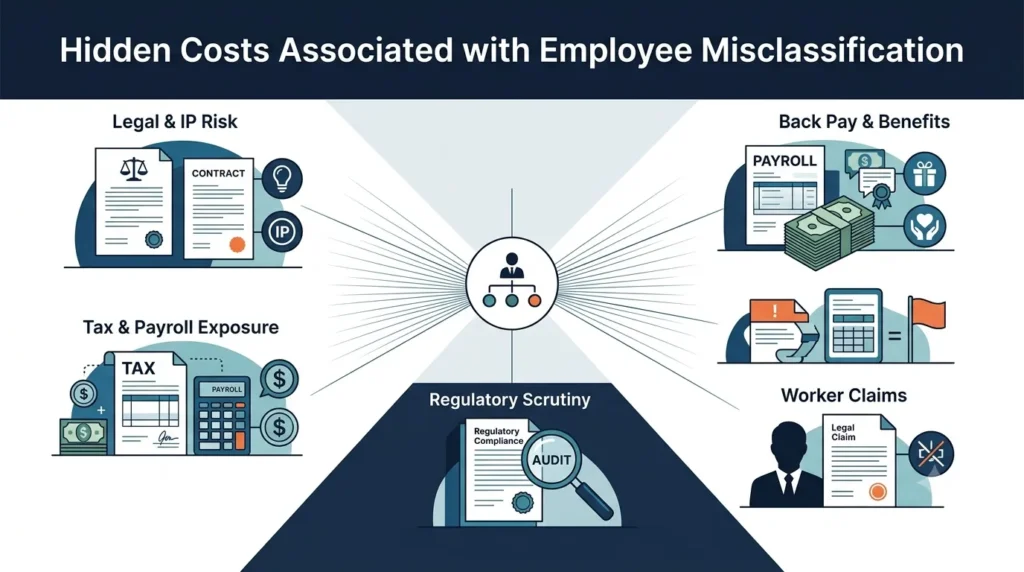
1. Intellectual Property (IP) Vulnerability:
Misclassification can also create intellectual property complications. Ownership rules differ by jurisdiction and may depend on whether the creator is an employee or an independent contractor and what the underlying agreement provides.
In the United States, for example, works created by employees within the scope of employment can qualify as “works made for hire,” while certain commissioned works created by independent contractors can qualify only under specific statutory conditions. Written agreements can also play an important role in establishing ownership. U.S. Copyright Office
For companies whose core value depends on software, designs, content, research, or other intellectual property, unclear ownership can create additional legal and commercial risk. These issues can become particularly important during investment due diligence, financing, or an acquisition, when companies may need to demonstrate that they have clear rights to the intellectual property supporting their business.
2. Back Pay, Employment Taxes, and Benefits Liabilities
One of the most immediate risks of employee misclassification is financial liability for obligations that should have applied to the worker.
Depending on the jurisdiction and applicable laws, a company may face claims involving unpaid wages, overtime, employment taxes, statutory benefits, interest, penalties, or other amounts owed for the relevant period.
In the United States, the IRS states that when a business incorrectly classifies an employee as an independent contractor without a reasonable basis, the business may be liable for employment taxes relating to that worker.
Wage exposure can also become significant. The U.S. Department of Labor has recovered back wages and damages in cases involving workers who were misclassified as independent contractors. In one case, 68 workers were found to have been misclassified, resulting in more than $106,248 in back wages and damages.
In another case involving 29 workers, the U.S. Department of Labor obtained a judgment requiring a contractor to pay nearly $1.2 million in back wages, damages, and penalties after finding that employees had been misclassified as independent contractors and denied proper overtime pay.
These examples demonstrate why misclassification should not be viewed simply as an HR paperwork issue. A classification decision can create financial exposure that grows with the number of affected workers and the length of time the arrangement continues.
3. Regulatory Scrutiny and Claims from Affected Workers
Employee misclassification can also attract regulatory attention and expose companies to claims from affected workers.
Under the U.S. Fair Labor Standards Act, workers who qualify as employees may be entitled to minimum wage and overtime protections. The U.S. Department of Labor identifies misclassification as a serious issue because workers incorrectly treated as independent contractors may lose statutory wage protections and other benefits.
The risk can increase when several workers are engaged under the same classification model. If the same practices are applied across a large contractor workforce, a compliance problem affecting one worker can potentially extend to many others.
This is particularly important for companies scaling internationally. A contractor model that appears simple when a company has one or two workers can become considerably more complex when dozens of people are working across multiple jurisdictions.
4. Tax and Payroll Exposure
Misclassification can create a second layer of risk through payroll and employment taxes.
In the United States, employers generally have different tax obligations for employees and independent contractors. When an employee is incorrectly treated as an independent contractor, the business may become liable for employment taxes that should have been withheld or paid. IRS
The IRS also notes that workers who believe they have been improperly classified may have mechanisms available to report uncollected Social Security and Medicare taxes. IRS
For companies operating across borders, the challenge is even greater because tax and payroll requirements vary between jurisdictions. A classification error can therefore affect not only the employment relationship but also the company’s payroll reporting and tax compliance processes.
5. Loss of Employee Protections and Increased Compliance Risk
The consequences of misclassification do not fall exclusively on the business.
According to the U.S. Department of Labor, workers who are incorrectly classified as independent contractors may be denied protections such as minimum wage and overtime pay, depending on the applicable law.
This creates a broader compliance problem for companies. The longer an incorrect classification remains in place, the more difficult and potentially expensive it can become to correct.
For fast-growing companies, the real danger is not simply making one classification mistake. It is scaling that mistake across countries, teams, and years of employment.
Global Payroll Penalties and Tax Consequences
Employee misclassification can quickly become a payroll and tax problem when a worker who should have been treated as an employee is instead paid as an independent contractor.
Employees and independent contractors are generally subject to different tax and payroll treatment. When a company gets that classification wrong, it may become responsible for employment taxes, unpaid payroll obligations, penalties, interest, or other liabilities, depending on the jurisdiction and circumstances.
In the United States, for example, employers generally have employment-tax responsibilities for employees, including federal income-tax withholding and Social Security and Medicare taxes. Payments to independent contractors are generally handled differently. The IRS explains that businesses that incorrectly classify employees as independent contractors may become liable for employment taxes.
The financial exposure can become significant when the classification error continues over an extended period. A company that engages one contractor may initially face a relatively contained problem. But if the same classification model is used for dozens or hundreds of workers, the potential exposure can multiply quickly.
The problem becomes even more complex when companies expand internationally. Payroll, social-security contributions, employment taxes, statutory benefits, and reporting requirements vary from one jurisdiction to another. A classification decision that appears reasonable in one country cannot automatically be applied to another.
This is why international companies cannot treat worker classification as a simple contractual decision. The classification must be evaluated against the rules that apply where the worker actually performs the work and the specific facts of the working relationship.
The longer a misclassification remains undetected, the greater the potential financial exposure can become. What began as an attempt to simplify hiring can ultimately create additional payroll work, tax liabilities, penalties, and compliance costs when the company has to correct the situation.
For growing companies, the lesson is straightforward: payroll compliance should be considered at the beginning of an international hiring relationship—not after a tax authority, labor regulator, or worker raises a classification issue.
Companies comparing global payroll platforms can also explore our Deel vs Papaya comparison for a closer look at payroll, compliance, and international hiring.
Contractor vs Employee: Understanding the Difference
One of the most important steps in preventing employee misclassification is understanding the difference between an employee and an independent contractor.
The distinction is not simply about what a worker is called, how they are paid, or what the contract says. In many jurisdictions, authorities look at the actual relationship between the worker and the company, including the degree of control, financial independence, and the nature of the work.
In the United States, for example, the IRS considers factors related to behavioral control, financial control, and the relationship between the parties when determining whether a worker is an employee or an independent contractor.
The U.S. Department of Labor also applies its own framework under the Fair Labor Standards Act when assessing whether a worker is an employee or an independent contractor. Its current guidance emphasizes that misclassification can deprive workers of protections such as minimum wage and overtime rights.
Employee vs. Independent Contractor
| Factor | Employee | Independent Contractor |
|---|---|---|
| Control | Company generally has greater control over how work is performed | Worker generally has greater independence over how work is performed |
| Work relationship | Often an ongoing relationship integrated into company operations | Often provides services as an independent business |
| Payment | Typically paid wages or salary through payroll | Typically paid for services or projects |
| Benefits | May receive employment benefits and statutory protections | Generally does not receive the same employee benefits |
| Financial independence | Usually has fewer opportunities for profit or loss from the work | May have greater opportunity for profit or loss |
| Tools and expenses | The company may provide equipment or reimburse expenses | Contractor may provide tools and bear business expenses |
| Other clients | Relationship may involve ongoing commitment to employer | Generally operates an independent business and may serve other clients |
These differences are not universal legal rules that apply identically in every country. Employment classification is jurisdiction-specific, and the same working arrangement can be assessed differently depending on the applicable law.
The IRS, for example, notes that the method of payment alone does not determine classification. Its guidance considers the overall relationship, including whether the business has the right to control how the worker performs the services.
Financial independence can also matter. Factors such as a worker’s investment in tools and equipment, unreimbursed expenses, opportunity for profit or loss, and ability to offer services to the broader market can point toward an independent business relationship.
Why the Distinction Matters for Global Companies
For a company hiring internationally, determining worker status becomes more complicated because employment and tax rules differ between countries.
A company may believe that a contractor arrangement is appropriate because the worker works remotely, invoices the company, or has signed an independent-contractor agreement. However, those factors alone may not settle the legal question.
The greater the company’s control over the worker and the more integrated the worker becomes within the company’s core operations, the more important it becomes to examine whether the arrangement is consistent with the applicable employment rules.
This is why companies should evaluate worker classification before hiring internationally rather than waiting until a payroll review, tax audit, labor complaint, or regulatory investigation raises the issue.
The key question is not simply “What does the contract call this worker?” It is “What does the actual working relationship look like under the law that applies?”
Employee Misclassification Around the World
Employee misclassification becomes significantly more complicated when a company operates across borders. There is no single global test for determining whether a worker is an employee or an independent contractor. Each jurisdiction can apply its own definitions, tests, employment rights, tax rules, and enforcement mechanisms.
A classification approach that appears appropriate in one country should therefore never be automatically applied to workers in another. The legal status of a worker depends on the rules that apply to the specific relationship and the jurisdiction involved.

United States
In the United States, worker classification can involve different legal frameworks depending on the issue being assessed. For federal tax purposes, the IRS considers factors related to behavioral control, financial control, and the relationship between the parties when determining whether a worker is an employee or an independent contractor. The U.S. Department of Labor applies a separate framework under federal wage-and-hour law and, in February 2026, announced a proposed rule that would revise its analysis under the Fair Labor Standards Act.
This means that a company cannot rely solely on the label used in a contractor agreement. The actual circumstances of the working relationship can determine how the worker is treated under applicable law.
United Kingdom
The United Kingdom illustrates another layer of complexity because employment status can differ between employment law and tax law. GOV.UK recognizes several employment statuses, including employee, worker, and self-employed or contractor, with different rights and responsibilities attached to each.
HMRC guidance also makes clear that determining employment status requires consideration of the nature of the relationship and the relevant facts. Employers cannot simply choose the status they prefer; the classification should reflect the terms and circumstances of the engagement.
Getting the classification wrong can result in additional tax and National Insurance liabilities, as well as potential interest and penalties depending on the circumstances.
Australia
Australia provides another important example of why companies should not rely on a single global contractor policy.
For constitutionally covered businesses, changes that took effect on 26 August 2024 introduced the “whole of relationship” test for determining whether a worker is an employee or independent contractor. The Fair Work Ombudsman explains that the assessment considers the real substance, practical reality, and true nature of the relationship.
This approach demonstrates an important principle for international employers: the written contract may be only one part of the classification analysis. How the relationship operates in practice can be critical.
Why This Matters for Global Companies
Consider a company that develops a contractor policy in its home country and then uses the same agreement for workers in ten additional markets.
The company may believe it has created a consistent and efficient hiring process. In reality, it may have created ten separate compliance questions.
Employment status can affect payroll, taxes, benefits, employment protections, reporting obligations, and the company’s responsibilities toward the worker. The more countries a company enters, the more difficult it becomes to manage these requirements manually.
This is why international hiring requires more than a standard contractor agreement. Companies need a process that evaluates the worker’s status against the rules of the relevant jurisdiction before the relationship begins and as the relationship evolves.
Global expansion does not create one compliance problem. It creates a network of local compliance obligations—and worker classification is one of the most important links in that network.
Five Warning Signs of Worker Misclassification
Employee misclassification is not always obvious when a worker is hired. A contractor agreement may appear straightforward at the beginning, but the actual working relationship can gradually start to resemble employment.
For growing companies, recognizing the warning signs early can help prevent a classification problem from becoming a larger payroll, tax, or employment-law liability.
While the exact legal tests vary by jurisdiction, the following situations should prompt companies to take a closer look at how their contractors are engaged.
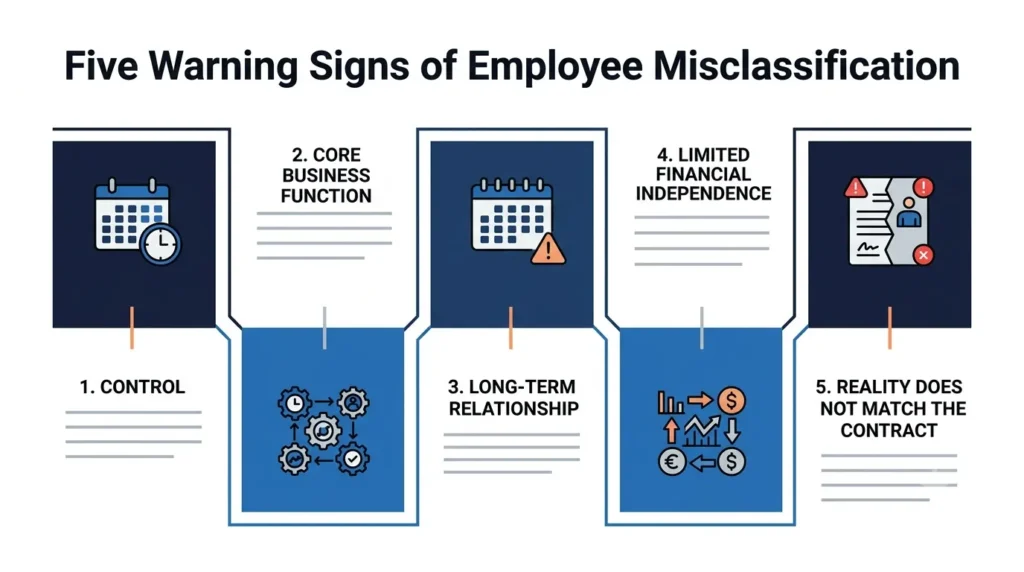
1. The Company Controls When, Where, and How the Worker Works
One of the clearest warning signs is a high degree of control over how a worker performs their job.
If the company determines when the person works, where they work, what tools they use, what procedures they must follow, or how the work should be performed, those factors can point toward an employment relationship in jurisdictions where control is relevant to classification.
The IRS, for example, considers behavioral control when evaluating whether a worker is an employee or an independent contractor. The analysis can include instructions about when and where to work, what tools or equipment to use, and what sequence or procedures to follow.
For international companies, the important question is not whether a manager occasionally provides instructions. It is whether the company has retained a level of control that is inconsistent with genuine independent business activity.
2. The Worker Performs a Core Function of the Business
Another warning sign appears when a contractor performs work that is central to the company’s business.
A worker who performs a key function of the business may be more closely integrated into the organization than an independent contractor providing a specialized service for a defined project.
For example, a software company that continuously relies on the same individuals to develop its core product may need to examine the nature of those relationships carefully. The fact that the workers submit invoices or work remotely does not, by itself, determine their legal status.
The more essential the worker’s role becomes to the company’s ongoing operations, the more important it is to evaluate whether the arrangement remains consistent with the applicable classification rules.
3. The Relationship Looks Indefinite Rather Than Project-Based
Independent contractors are often engaged to provide services for a particular project, defined period, or specific business objective. A relationship that is expected to continue indefinitely can raise a different classification question.
An ongoing relationship does not automatically make someone an employee. However, permanence is one of the factors that may be relevant when authorities evaluate the overall relationship.
This becomes particularly important when a contractor starts with a short-term assignment but gradually becomes a permanent member of the company’s operations, receives ongoing responsibilities, and continues working under the same arrangement for years.
Companies should therefore reassess contractor relationships as they evolve rather than assuming that the original classification remains appropriate indefinitely.
4. The Worker Has Little Financial Risk or Independence
A genuine independent business will often have some degree of financial independence from the client.
Warning signs can include little or no investment in the tools required to perform the work, few unreimbursed business expenses, limited opportunity for profit or loss, and no meaningful effort to offer services to the broader market.
These factors do not automatically determine classification. Instead, they should be considered as part of the overall relationship.
For example, a worker who depends almost entirely on one company for income, uses equipment provided by that company, receives regular payments, and has little opportunity to generate a profit or loss from the way the work is performed may warrant a closer classification review.
5. The Contract Says “Contractor,” but Reality Says Otherwise
Perhaps the most dangerous assumption is believing that the wording of a contract settles the classification question.
A written agreement is important, but it does not necessarily override the reality of the working relationship. If the company treats a contractor like an employee in practice, the classification may need to be reconsidered under the applicable law.
This can happen when a contractor works fixed hours, reports to a manager, receives detailed instructions, uses company equipment, performs an ongoing core function, and is subject to the same operational expectations as employees.
The key lesson is simple: a contractor agreement should reflect the actual relationship—not attempt to disguise it.
Companies should periodically review long-term contractor arrangements to determine whether the relationship has changed enough to require a different employment structure.
How to Prevent Employee Misclassification Before It Becomes Expensive
Preventing employee misclassification is easier than correcting it after years of incorrect payroll, tax, or employment treatment.
The first step is to evaluate the relationship before the worker starts. Companies should consider the applicable classification rules in the country where the work will be performed and document why the chosen employment structure is appropriate.
But classification should not be treated as a one-time decision. International working relationships can change as companies grow. A contractor who initially provides a defined service may eventually become deeply integrated into the company’s operations, take on permanent responsibilities, or become subject to greater managerial control.
A strong international hiring process should therefore include several layers of protection.
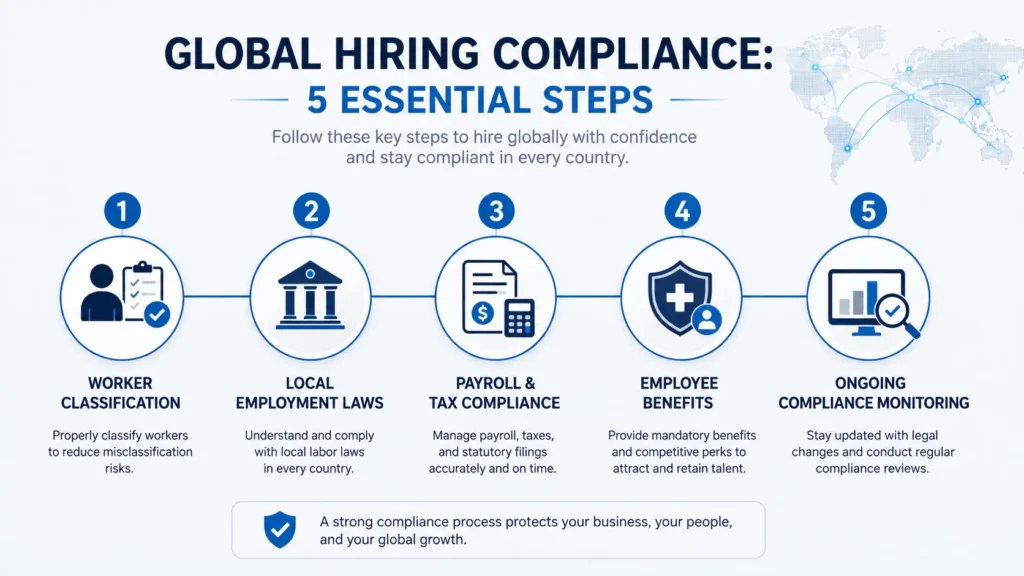
1. Evaluate Worker Classification Before Hiring
Before engaging an international worker, companies should determine whether the intended relationship is genuinely compatible with independent-contractor status under the relevant local rules.
This assessment should consider factors such as control, independence, permanence, financial risk, the nature of the work, and how the worker will interact with the company.
The goal is not simply to select the cheapest or fastest hiring model. It is to select a structure that accurately reflects the relationship and can remain compliant as the business grows.
2. Use Locally Appropriate Employment Contracts
International employment contracts should reflect the requirements of the jurisdiction where the employee works.
A generic contract created for one country may not address mandatory local requirements in another. Depending on the jurisdiction, companies may need to account for statutory benefits, working-time rules, termination requirements, payroll obligations, leave entitlements, and other employment protections.
Using locally appropriate employment documentation can reduce the risk of relying on a contract that does not properly reflect the applicable employment framework.
3. Review Contractor Relationships Regularly
Worker classification should not be considered a “set it and forget it” decision.
Companies should periodically review long-term contractor relationships, particularly when responsibilities change, the worker becomes more integrated into the business, or the relationship becomes open-ended.
A periodic review can identify potential classification problems before they become larger liabilities.
4. Build a Scalable Global Hiring Process
The challenge becomes greater when a company hires in multiple countries.
Managing classification, contracts, payroll, benefits, taxes, and local employment requirements independently in every market can quickly create administrative complexity.
For companies planning continued international expansion, the hiring infrastructure itself becomes an important compliance decision.
This is where an Employer of Record can provide an alternative to establishing and managing a local employment infrastructure from scratch.
How an Employer of Record (EOR) Helps Companies Stay Compliant
An Employer of Record (EOR) can help companies hire employees internationally without requiring the company to establish its own legal entity in every country where it wants to hire.
Under an EOR model, the EOR becomes the legal employer of the worker while the client company typically retains responsibility for the employee’s day-to-day work, role, and performance management.
The EOR can handle employment contracts, payroll, benefits administration, and other local employment requirements, depending on the provider and jurisdiction.
This can give growing companies a more structured way to enter new markets while reducing the administrative burden associated with managing employment infrastructure across multiple countries.

Local Employment Infrastructure
Establishing a local entity can be appropriate for companies making a long-term commitment to a market. However, it can also require incorporation, local administration, payroll infrastructure, tax registrations, and ongoing compliance management.
An EOR provides another route. Instead of creating a new legal entity for every market, a company can use the EOR’s existing employment infrastructure to hire eligible employees in supported countries.
This can be particularly useful when a company wants to test a new market, hire its first employee in a country, or expand internationally without immediately building a full local operation.
Payroll and Tax Administration
International payroll is more than sending a salary to a bank account.
Companies may need to manage local payroll calculations, statutory deductions, employer contributions, benefits, reporting requirements, and payment schedules.
An EOR can centralize many of these administrative responsibilities and apply country-specific payroll processes through its local infrastructure.
This does not eliminate the company’s responsibility to make sound hiring decisions, but it can reduce the operational complexity of managing employment across multiple jurisdictions.
Employment Contracts and Local Requirements
Employment contracts are another area where international hiring can become complicated.
Requirements relating to compensation, leave, benefits, notice periods, termination, working hours, and other employment conditions can differ significantly between countries.
An EOR can provide locally appropriate employment contracts and administer employment relationships according to the requirements of the relevant jurisdiction.
For growing companies, this can reduce the need to create and maintain a separate employment framework for every market.
Reducing Administrative Complexity
The value of an EOR is not simply that it can help a company hire abroad. It is that it can consolidate many of the administrative processes involved in international employment.
Instead of building separate payroll and employment processes for every new country, a company can manage international employees through a more centralized operational structure.
This can allow founders, HR teams, and finance departments to spend less time coordinating local employment administration and more time focusing on growth.
Supporting International Expansion Without Creating a Local Entity
For companies that need to hire internationally before establishing a permanent local presence, an EOR can provide a practical path into new markets.
It can allow a company to hire eligible employees through an existing local employment structure while the business evaluates whether establishing its own entity makes strategic sense.
This is particularly relevant for startups and scale-ups that want to validate international demand before committing significant capital and administrative resources to a new market.
EOR vs. Local Entity: Which Is Right for a Growing Company?
| Factor | Employer of Record (EOR) | Local Entity |
|---|---|---|
| Setup | Can allow hiring without establishing the company’s own local entity | Requires establishing and maintaining a local legal entity |
| Speed | Generally faster for entering a new market | Usually requires more setup and administration |
| Payroll | EOR manages local payroll processes. | The company manages or arranges its own payroll infrastructure. |
| Employment compliance | EOR handles many local employment obligations. | The company is responsible for local compliance. |
| Upfront complexity | Lower operational complexity | Higher administrative and legal complexity |
| Control | The company manages the day-to-day work, while EOR is the legal employer. | The company directly employs workers through its own entity. |
| Best suited for | Testing markets, initial hires, and faster international expansion | Long-term operations with a substantial local presence |
Neither model is universally better. The right choice depends on the company’s growth strategy, expected headcount, market commitment, budget, and need for local infrastructure.
For a company hiring one or a few employees in a new market, an EOR can offer a faster way to establish an employment relationship without immediately creating a local entity. For a company building a substantial long-term operation, establishing its own entity may eventually provide greater direct control and a more permanent local presence.
How Deel Helps Companies Hire Globally
Deel provides an Employer of Record solution designed to help companies hire and manage employees internationally without setting up their own local entities in every market. Our Deel vs. Oyster comparison also examines how the two platforms approach global hiring.
Through its EOR infrastructure, Deel handles key employment processes, including local employment contracts, payroll, benefits administration, and compliance requirements, while the client company continues to manage the employee’s day-to-day role and performance.
For companies concerned about employee misclassification and international employment complexity, this type of infrastructure can provide a more structured alternative to managing contractor relationships across multiple countries. You can also see our detailed analysis of whether Deel is worth it for growing businesses.
For contractor engagements, Deel’s Contractor of Record service can also take on worker classification and related misclassification liability, giving companies an additional layer of protection as they scale internationally.
Ready to simplify international hiring?
If you’re planning to hire employees internationally and want to explore an EOR solution, you can book a free demo with Deel and discuss your hiring needs with their team.
Hire Employees Without Opening a Local Entity
One of the main advantages of an EOR is the ability to hire employees in supported countries without establishing the company’s own legal entity in each market.
This can reduce the time and administrative work associated with entering new markets, particularly when a company needs to make an initial hire before deciding whether to establish a permanent local operation.
Manage Payroll and Local Employment Requirements
Deel’s EOR model combines employment administration with local payroll and compliance processes.
This can help companies avoid building separate payroll workflows for every country while maintaining a centralized approach to managing their international workforce.
Stay Ahead of Changing Compliance Requirements
International employment rules can change over time, making compliance an ongoing responsibility rather than a one-time setup task.
Deel describes its compliance infrastructure as monitoring regulatory changes and checking worker data against country-specific requirements across payroll, contracts, and employment status.
For growing companies, having a system designed to monitor local requirements can reduce the risk of relying on outdated processes as the workforce expands.
Key Takeaways
Employee misclassification is more than an HR classification issue. For companies expanding internationally, it can create tax, payroll, employment, financial, and operational exposure.
The key lessons are:
1. Classification should reflect reality.
Calling someone a contractor does not automatically make them an independent contractor.
2. Country matters.
Worker-classification rules differ between jurisdictions.
3. Relationships can change.
An appropriate contractor arrangement initially may need to be reassessed as the worker becomes more integrated into the business.
4. Compliance should scale with the workforce.
A process that works for one international hire may become difficult to manage when a company has workers across ten or twenty countries.
5. An EOR can reduce operational complexity.
For companies that need to hire internationally without immediately establishing local entities, an EOR can provide employment infrastructure, payroll administration, and local compliance support.
6. The goal is not simply to hire faster.
The goal is to build an international workforce that can scale without creating unnecessary compliance risk.
Frequently Asked Questions
What is employee misclassification?
Employee misclassification occurs when a company treats a worker as an independent contractor or another type of non-employee when the applicable law considers the relationship to be employment.
What happens if an employee is misclassified as an independent contractor?
Depending on the jurisdiction and circumstances, a company may face claims involving unpaid wages, employment taxes, benefits, interest, penalties, or other liabilities. The financial exposure can increase when the same classification is applied to multiple workers over an extended period.
Can a contract prevent employee misclassification?
No. A contract is an important part of an employment relationship, but the contract’s label does not necessarily determine worker status. Authorities may consider how the relationship actually operates.
How can companies avoid employee misclassification?
Companies should evaluate worker classification before hiring, use locally appropriate employment arrangements, review long-term contractor relationships, and reassess classification when the nature of the relationship changes.
Can an EOR help prevent employee misclassification?
An EOR can help companies employ workers through a local employment structure and manage employment contracts, payroll, benefits, and other local requirements. However, companies should still evaluate their hiring model and the specific circumstances of each worker.
Is employee misclassification illegal?
The consequences depend on the applicable jurisdiction and law. Misclassification can result in tax, wage, employment, and other liabilities when a worker who legally qualifies as an employee is treated as an independent contractor.
Final Thoughts
Global expansion should create opportunities—not hidden liabilities.
Employee misclassification can begin with a seemingly simple decision: hiring someone as a contractor instead of an employee. But as a company grows, that decision can affect payroll, taxes, employment rights, intellectual property, and compliance across multiple jurisdictions.
The safest approach is to evaluate worker classification before the relationship begins, monitor how that relationship evolves, and use an employment structure that can scale with the company’s international ambitions.
For companies that need to hire employees internationally without immediately establishing local entities, an Employer of Record can provide a practical way to build global teams while reducing the administrative burden of managing employment across multiple markets.
Ready to explore international hiring with less complexity?
Affiliate Disclosure: Some links on this page are affiliate links. If you sign up for a service through these links, EarnGoGo may earn a commission at no additional cost to you. Our recommendations are based on our research and analysis.

James B. has 8 years of experience in online business and digital publishing. At EarnGoGo, he researches and writes about HR, payroll, global employment, and employment compliance, focusing on how technology and AI are changing the way companies hire and manage international teams.